

Understanding Eve and Adam
Faith Matters resources to accompany your Come Follow Me study: Jan 19-25
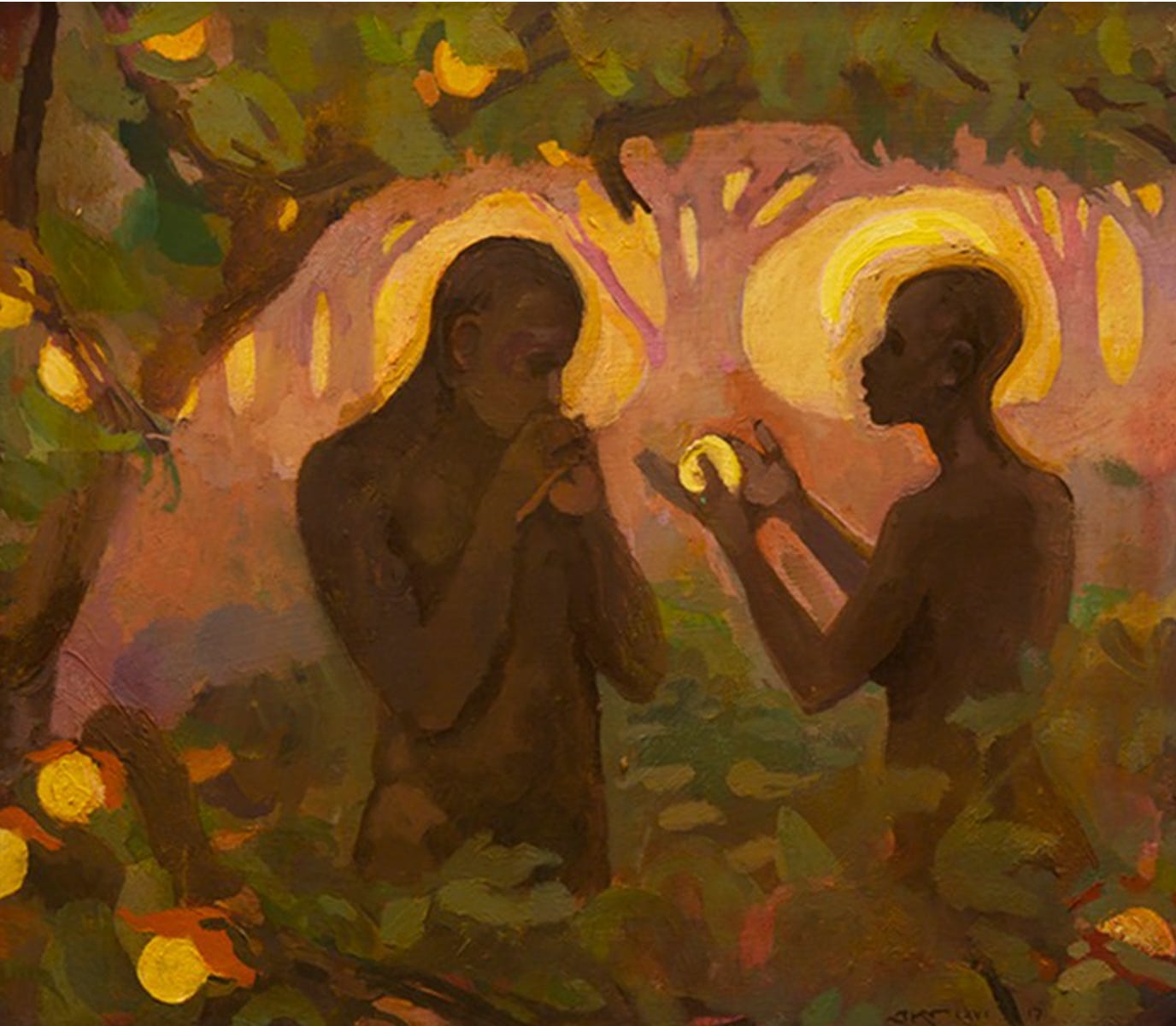
Melinda Wheelwright Brown: Eve and Adam

This week, we were lucky enough to spend some time with Melinda Wheelwright Brown, to talk about her book Eve and Adam: Discovering the Beautiful Balance, which was published by Deseret Book. The book does an amazing job of getting into the details of what we learn in the Bible, in the Pearl of Great Price, and from other sources, and shows us how unfortunate misunderstandings, or worse, have led many over the centuries to relegate women into a place of submission or even contempt. Not only does Mindy show that Eve is very much Adam’s equal, but that she deserves her own special place of honor and respect — one that the restoration does much to bring back.
The Fall was a necessary part of God’s plan.


Jesus Christ offers hope and redemption. Jesus Christ saves us from the Fall.

What does it mean that Adam was to “rule over” Eve?
The Proclamation… boldly claims that men and women are intended, by divine design, to be “equal partners.”
As a result, it seems increasingly obvious to me that, in our day, defending the family means rooting out our world’s misogyny.
Defending the family means defending women from both the subtle and violent forms of degradation, abuse, and marginalization that riddle our world. It means taking seriously—perhaps for the first time in the history of the world—the solemn declaration that God intends men and women to be equal partners.
In my view, this will be the defining moral issue of our generation.


I need agency and opposition to grow. I can choose the right.
While in the temple one day, I understood something new through the narrative. In my own personal study I had learned that the Hebrew word אָדָם, translated as Adam, means “earthling” or “humankind.” The Hebrew word חַוָּה, or Eve, means “life,” specifically “divine life;” that is why she is the mother of all living. As I watched the narrative, I thought of how the natural man in all of us, or the Adam, chooses to stay in paradise where there is no growth because there is no discomfort. The divine life in all of us, or the Eve, chooses to receive knowledge of good and evil, even though it causes pain and suffering, because it is also the only way to find joy.
—Abigail Eve Harper, “Temples of Flesh and Blood”

“The woman made me.” “The serpent tempted me.” If we look for that paradigmatic moment, that morally instructive part of the story upon which to build our own life of discipleship, it seems to be this: Agency means the freedom to choose. If not our first, impulsive response to the world, then our response to that self we have just witnessed. And in that response, we are free to grow in a more and more godly direction until we are perfect in Christ.
—Terryl Givens, “The Primal Sin”


Satan seeks “to deceive and to blind” me.
Elizabeth Oldfield: Fully Alive

In this conversation, Elizabeth Oldfield explores the concept of sin through examining the seven deadly sins. She asks, What can envy teach us about having a stable sense of self, especially in this age of social media? Is acedia, or sloth, really about attention? How can we continually recall our attention to the things we hope will shape our souls? Elizabeth demonstrates that at the end of the day, the seven deadly sins aren’t a legalistic list of ways to be in debt to God, but a loving guide for how to be in right relationship with the people around us.
Read an excerpt from Elizabeth’s book Fully Alive, included in Issue 4 of Wayfare, where she explores the modern temptation of acedia, or an inattention to life, and offers concrete suggestions and spiritual practices for overcoming it:

Read more about the temptation of acedia in “Sitting in the Dark” by Duncan Reyburn, also included in Issue 4 of Wayfare:

Matthew Bowman examines the temptation to idolatry in “Spiritual Cartography”:
Martin Luther said that “whatever your heart clings to and relies upon, that is your God.” Idolatry tempts you to invest a fallible and limited human idea or institution or practice with absolute faith and confidence. Idolatry is the child of certainty. It leads you to reject the possibility that you might be wrong. …
Because we worry about our own flaws, we invest power in things that we hope will protect us from failure. We project confidence, we feign certainty, we embrace righteous anger. We believe in simple answers. And then we grow vehement about defending the things we have invested in, since deep down the anxiety remains, because money or ideology or doing this thing or that won’t help you fix all the ways this world is broken. It can’t.
Idolatry destroys because it is a product of anxiety that only feeds that anxiety in turn. Idolatry is like scratching a mosquito bite; it is satisfying in the moment, but in the long run the underlying problem only grows more inflamed.
(Learn more about the sin of certainty in our conversation with Pete Enns.)
Thomas McConkie teaches us more about where sin comes from and how to follow the example of Jesus Christ in overcoming temptation in “Divine Vulnerability”:
The moment we feel intense sensations building up in our bodies, our instinct is to escape. In an effort to escape the reality of our embodied vulnerability, we often say things and do things that are harmful to ourselves and to others. We justify our actions because we feel at a deep level that if we don’t do something to escape, we’ll be overwhelmed with pain, or possibly harmed beyond repair. In a gospel context, we can understand this psychological process as the drive toward sin. … In our worst moments, we’ll justify any kind of behavior it takes to escape the specter of being swallowed alive by our core vulnerabilities. Sin in this sense is a vain but understandable attempt to avoid our deepest suffering. …
To the extent that we’re willing to not only endure but embrace our personal Gethsemanes, we curtail sin’s capacity to tempt us. After all, if we’re willing to feel absolutely every experience that the Divine consecrates for our sanctification, what need is there to act out? What power does sin have to tempt us in the end? Christ is the living incarnation of this path.
… The task is simple but difficult: Let your eye be single to God’s Glory. Let this sanctifying Light infuse the most vulnerable parts of yourself again and again. In exactly the most disturbing moments of your life, you can train yourself to open up, relax, and trust that something from beyond is making you holy.
… Every time we crash, every time we fall apart, we can stop and realize that this is an opportunity to be tender and fully embodied with this disturbance, with the most vulnerable parts of our humanity. As we do this, we discover exactly where we stand in need of healing. We feel our wounded humanity being redeemed.
“I, the Lord God … clothed them.”
In the Judeo-Christian garden story, partaking of the fruit of the tree of the knowledge of good and evil precipitates the fall and opens Adam and Eve’s eyes to their nakedness, which is to say, to their brokenness or vulnerability on the one hand and to their physical attractiveness on the other. Nakedness thus serves as an important metaphor in the biblical account for the birth of opposites, namely fear and desire. So, if opposites coming into Adam and Eve’s purview coincides with covering themselves and entering a fallen state, then, by analogy, reclaiming that former state of wholeness would suggest unlearning opposites and uncovering oneself, which is to say, experiencing a second or spiritual birth—naked as it were—and an awakening to the underlying oneness of all things.
—Tony Brown, “Fire and Water”
I suggest that the garment is neither a vestige of a magical worldview nor an arbiter of Victorian ideals of modesty; rather, its purpose is to be formative of a person’s subjectivity. It forms Latter-day Saints as consecrated individuals and forms us as followers of and in likeness to Christ, who epitomized consecration. The garment is symbolic of the veil of the temple, which is not only symbolic of Christ but is also the place in which we present ourselves before the divine. In an embodied way, we pronounce our total presence, availability, and openness to divine call, the tangible equivalent of verbal exclamations of women and men in the scriptures who played pivotal roles in salvation history by declaring, “Here I am!” Such a pronouncement is to me the essence of consecration, and I believe that the garment represents my perpetual position before the veil, reminding me that I am forever at the disposal of the divine.
—Deidre Nicole Green, “Clothing Ourselves in Christ”
God will accept my sacrifices if I offer them with a willing and obedient heart.
My chronic grief about not being a great musician makes me wonder earnestly about the disconnect between what I think God would like and what I can actually give. It occurs to me sometimes that most of what we bring to the altar is not nearly as valuable as we suppose. The difficulty of figuring out what the Lord wants from us is illustrated in Genesis by Cain’s rejected sacrifice, articulated again in Samuel’s insistence that “to obey is better than sacrifice,” and the psalmist’s recognition that “thou desirest not sacrifice; else would I give it: thou delightest not in burnt offering. The sacrifices of God are a broken spirit: a broken and a contrite heart, O God, thou wilt not despise.” The Nephites are instructed that their “burnt offerings shall be done away, for I will accept none of your sacrifices and your burnt offerings.” And just before the Saints at Kirtland are asked to give a tithe of money to build the temple, a new kind of sacrifice, they’re reminded that “all among them who know their hearts are honest, and are broken, and their spirits contrite, and are willing to observe their covenants by sacrifice—yea, every sacrifice which I, the Lord, shall command—they are accepted of me.”
Perhaps we need to be told exactly what to sacrifice because we aren’t very good at recognizing what is valuable. Maybe Paul’s description of gifts within the body of Christ isn’t just about other people’s gifts that we wrongly think are less worthy than our own, but about our estimation of what it is we ourselves have to offer.
Nay, much more those members of the body, which seem to be more feeble, are necessary:
And those members of the body, which we think to be less honourable, upon these we bestow more abundant honour; and our uncomely parts have more abundant comeliness.
For our comely parts have no need: but God hath tempered the body together, having given more abundant honour to that part which lacked.
Maybe artistic gifts, like all the others, are useful for bringing us to the place where we can offer all that we really have to give—our brokenness, our need, our yearning to know and be known.
—Kristine Haglund, “The Beauty of Holiness”

I can pray to Heavenly Father.

