

How can God dwell within me?
Faith Matters resources to accompany your Come Follow Me study: June 22 - 28
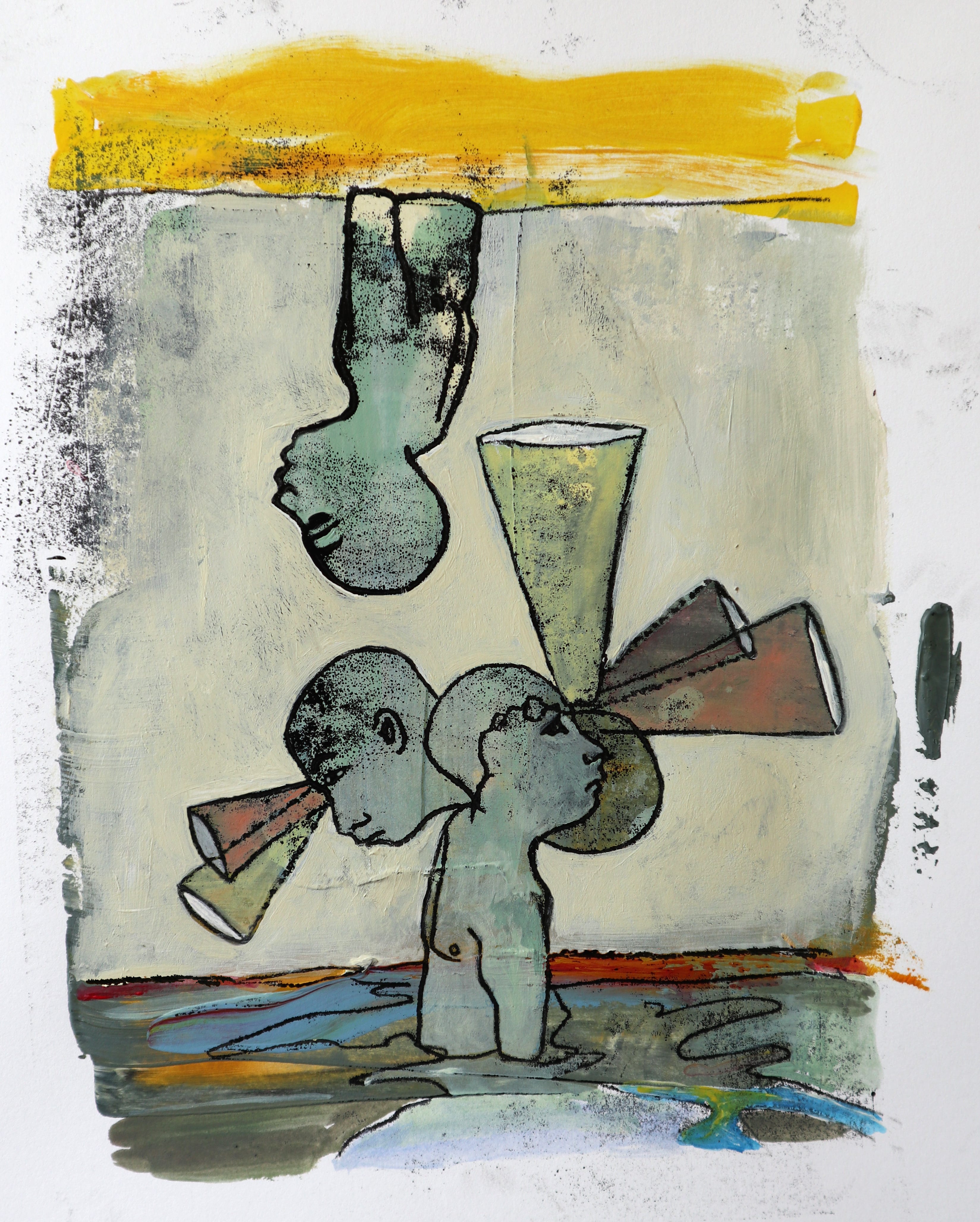
The Lord can help me make good choices when I am tempted to sin.
No, David was not a remarkable person. But he was a remarkable king. And you are also a king. You are not one thing but many. You are goodness and badness all knit together. And to be a good king is to be still. To look inside. To breathe. To hear. To know. And when you find weaknesses, look for hidden strengths. And when you find strengths, look for camouflaged weaknesses. And always look for help. Your friends and family are not perfect. But they will still fight for you. Look for their strengths. See their goodness. Trust that God can create an army out of broken pieces. And with this army, you will face giants. And when you do, don’t look away. Even if what you see is ugly, bad, and shameful. Be like David, look and trust. Because God is great enough to deliver you and everyone else from even the worst parts of ourselves.


The gift of discernment helps me distinguish between right and wrong.


The universe is like that; we think we are evaluating, assessing the merits of the music we hear, the painting before us, the words and deeds of friends or critics. In a sense, of course, we are called upon to discern and to choose. But in another, perhaps deeper sense, we do not ourselves determine what is good or beautiful, or worthy or wrong. We are always revealing the composition of our own souls in every act of passing judgment.
—Terryl Givens, “The Weight of Water”

Usually, a tree grows its branches until the crown encounters neighboring trees of the same height. Its branches stop growing instead of entering the others’ space, creating separation lines and boundaries in the sky. Rather than encroach, the tree finds greater benefit from coexistence. Trees have a sophisticated system for measuring light and telling time. They can tell whether light is coming from the sun or being reflected off leaves. When they discern that light is being reflected off leaves, they know there’s another plant nearby and that they need to slow down growth in that direction. It’s also a way for trees to optimize light exposure for everything under the canopy.
Above all things, our Mother Tree is love expanding outside of time. Her reach is endless. Her branches extend out into the world, responsive to seasonal changes, elemental shifts, and to all of Her children. She knows how they need to grow. In the crown of the tree, we begin to see as our Mother sees (D&C 76:7–10; 1 Cor. 13:12); we walk in the way of discernment (Prov. 9:6). In all the regions of the Mother Tree, we are taught how to distinguish truth from falsehoods, reality from delusions, and to embrace that which binds through love.
We heed the Mother’s voice in our hearts that says we are one.
As we learn to trust Her more, we in turn open ourselves to greater visions of what is real and lasting. “Farther up is further in.” We descend lower and lower and ascend higher and higher to continue to discover both ourselves and Her. In this process of remaking ourselves time and time again, we sink deeper into our own humanity and ascend higher into our divinity—the one embracing the other. We learn the holy power of the interconnectedness of all things past, present, and future. As we’ve seen, Her wisdom moves us to consider life at macro and cosmic levels.
—Kathryn Knight Sonntag, “Crown”
In the end, Solomon died and was buried. And worms and roots ate his flesh. And on top of his grave grew a few lily flowers. And they were more beautiful than any of Solomon’s palace rooms, or his throne, or his clothing. And before he died, he wrote one last proverb for the people to remember him by. And if he had a tombstone, he would have had this written across the front. Because it was the truest and wisest thing he ever wrote:
After everything I have learned and done, after gaining all the wisdom of God and spoiling it on myself, I have one conclusion: Obey God.
And he was right. Because ultimately, at the end of everything, God wants our hearts, not our minds. And to obey God is to serve him. And to serve him is to serve his children.

Through covenants made in the Lord’s house, the Lord dwells with me.
Find everything we’ve published in Wayfare on the temple experience here.
But according to Doctrine and Covenants 93, the idea of worship is more than just the location itself—it is understanding who God is and believing that we, too, can actually become all that he is. The crux of the section occurs in D&C 93:19, stating that we “may know what you worship, that you may come unto the Father in my name, and in due time, receive of his fullness.” Suddenly, mortality is more than Plato’s cave, where we are only able to glimpse the shadows and flickers of a life beyond this one. Rather, worship is an act of unalloyed submission toward God because we know that he can thrust us to heights that our finite minds cannot imagine.
—Sarah Shumway Day, “Lending a Child to the Lord”
Find everything we’ve published in Wayfare on covenants here.
The primary work of LDS rituals is to invite us into relationships. Sometimes the word Church members use to describe these relationships is “covenant,” a term that can feel archaic and even legal. Church members often talk about “covenants” as though they are contracts in which each signatory promises something contingent upon the performance of the other, as though the relationship with God established in the temple endowment ceremony is comparable to executing a mortgage agreement.
But I think that sort of interpretation reflects, again, the world of shopping and commerce modern Americans are used to, when in fact the implication of the rituals themselves points less to commercial contracts, in which two people exchange something, than to the establishment of kinships, which are personal relationships that cannot be obliterated even when one party behaves badly. All throughout scripture, after all, God declares that his covenant with his people will never be canceled even if the people violate it. Isaiah 54:10, for instance:
For the mountains shall depart, and the hills be removed; but my kindness shall not depart from thee, neither shall the covenant of my peace be removed, saith the Lord that hath mercy on thee.
The rituals of Latter-day Saint worship, I think, point us in this direction. They don’t exist to give us information that we need to better fulfill a contract. Instead, they invite us to behave as though we are always already in relationships in which we give to each other out of care and kinship.
—Matthew Bowman, “Rituals of Becoming”

“His heart was not perfect with the Lord.”

But as we still our hands and close our eyes during prayer, we are reminded that some of life’s most magnificent truths cannot be articulated. The ineffable will always remain irreplaceable; many of the things that matter most can only be understood, as the Little Prince once reminded us, as matters of the heart. Even if our hope is to make meaning of the information that flows into us unendingly from the digital world around us, we must make space away from those incessant inputs if we are to have hope of finding truth or meaning. Especially in a world where attention has been commodified, balkanized, and monetized, closing my eyes can represent a powerful and purposeful declaration that not all of my attention is for sale. Some sacred precincts of my heart and soul cannot be bought or sold on the open digital market; some private inner sanctum remains available only to me and to God.
…In this context, the act of bowing my head during prayer is a radical act of choosing the object of my devotion. Even if I can only glimpse the character of the divinity I worship, yet this is a God I can actively seek and to whom I choose to be devoted. Unlike the nameless and faceless algorithms that rule the digital universe, the God I seek to worship is a pair of Heavenly Parents who are infinitely defined by mercy, justice, hope, benevolence, and love. Thus, choosing to bow my head in deference to this definition of divinity is both a symbol of my humility before God’s love and also a manifestation of my commitment to become more loving.
—Tyler Johnson, “Form as Function”
“Humanity, created by God in all its grandeur,” writes Pope Leo in his 40,000-word encyclical on artificial intelligence, “is today facing a pivotal choice: either to construct a new Tower of Babel or to build the city in which God and humanity dwell together.”
It’s a stark contrast, the Tower of Babel or the City of God. As Pope Leo writes, Babel was “supported by a uniformity that eliminated diversity and that chose homogenization over communion” while the City of God, by contrast, “rebuilds relationships before rebuilding with stones” and “rediscovers a common language—not one of uniformity, but one of communion.”
…For Cheney, the core concern around AI has to do with maintaining our individual agency, which, alluding to a Latter-day Saint scripture, he defines as “the choice to act rather than be acted upon.” This is the central sentiment of his company’s manifesto (or “doctrine,” as Cheney calls it). It’s also a sentiment I encounter frequently in different tech circles on the Wasatch Front—a sentiment I find simultaneously inspiring and troubling.
…But we might ask: What if the primary problem we’re facing is that “those who choose to act” aren’t as introspective, generous, or wise as they should be? What if the problem isn’t so much a lack of bold action, but a lack of wisdom, which weaves together the active and passive elements of agency?
…If we are going to build the City of God we must stop laying the blame primarily on communities that are slow to adapt and start calling out those who use their agency to expand their dominion against the will of others.
We must, above all, recognize that without wisdom, what we call “progress” is, in reality, its opposite—an abandoned tower to nowhere.
—Jon Ogden, “Agency Without Wisdom”