

The practice of polygamy (technically polygyny) in the early history of the church, and the ongoing doctrine of eternal polygamy, is one of the biggest challenges to the faith of Latter-day Saints in the modern era. Many of us wrestle with this topic for years, often shelving it in basement storerooms of our minds because we don’t quite know how we should feel about it or how we can reconcile it.
We’ve wrestled with it ourselves. And, like many Latter-day Saints, we’re very much conflicted. Bill doesn’t have much plural marriage in his family tree. But Susan does, in a big way. So polygamy is part of our legacy and our children’s and grandchildren’s legacy. And it’s a mixed one.
The Milo Andrus Clan
Susan’s great-great grandfather, Milo Andrus, lived an extraordinary and colorful life. He received a powerful witness of the divinity of the Restoration, and embraced both the gospel and life with great faith and passion.
Milo marched with Joseph Smith in Zion’s Camp. He attended the School of the Prophets. He was a powerful missionary, converting, among many others, Heinrich Eyring, grandfather of chemist Henry B. Eyring. He led three wagon trains of pioneers to the Salt Lake Valley. Milo was a builder in every sense of the word. He helped build the Kirtland, Nauvoo, Salt Lake and St. George temples. He was a Bishop in Nauvoo, a Stake President in St. Louis, a member of the Quorum of the Seventy and a Patriarch. Historian Ivan J. Barrett wrote a biography of Milo that he titled “Trumpeter of God.”
When called to practice plural marriage, Milo seemed to embrace it with gusto, taking eleven wives who bore him 57 children! His descendants largely remained devout and today comprise one of the largest families in the church. Susan owes her existence to Milo and his 8th wife, Jane Lancaster Munday, who suffered much in life but responded with incredible courage, faith and resourcefulness. Our family has been directly blessed by them. And we share a gratitude for their legacy of faith, sacrifice and devotion.


We don’t know much about Milo and Jane’s private opinions of plural marriage. For the early saints, uprooted from their homes and often trying just to survive, marriage was often much more a matter of prudence and practicality than romance. It seems they generally tried their best to make the practice sacred in their lives. But it was… complicated.
In 1848, Milo was called on a mission to England. He opted to take his 2nd wife, Sarah Miles, with him. His first wife, Abigail Dailey, was left to trek across the plains with their five children. They nearly starved in the process, and things got even worse for a time after they settled in the Salt Lake valley. It broke her heart. Abigail married Milo at age 18 and never signed up for any of that. She didn’t choose polygamy—it was more or less thrust upon her. The emotional wounds were so deep that she eventually divorced Milo. She remarried, but divorced again when her second husband took another wife. Four decades after their divorce, Milo and Abigail reconciled and remarried. Once the love of his life, she was now wife #11. We don’t know what to make of that. We imagine she was conflicted. Maybe the surviving photo of Abigail captures it best.
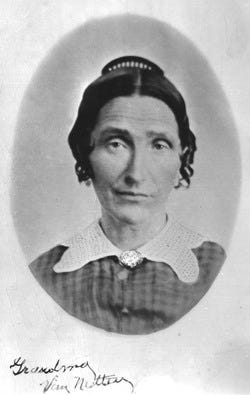
Unlike Abigail, however, the rest of Milo’s spouses DID choose polygamy. And we owe them the respect of honoring that choice. They lived, in many respects, honorable, sacred lives as they lived out that choice. Their situation was in no way ideal, but they seemed to make the best of it.
Susan’s father, a deeply good and faithful man, looked at Milo’s life, including his polygamy, with a degree of reverence—part of the Andrus legacy of sacrifice for the Kingdom. Susan’s mother, a saint in every sense of the word, feels somewhat differently about the Andrus plural marriage legacy.
We honor the early saints, including Susan’s ancestors, who took this very difficult thing they were asked to do and did their best to invite God’s blessings into it. And we know from their stories that God was very much present in their lives. Whatever we might say about their practice of polygamy, it was not enough to separate them from God’s grace and influence.
We try not to fall into the trap of presentism, judging their lives and choices through our contemporary lens.1 But we do not believe plural marriage was on balance a healthy or sacred practice.
The Taste of Polygamy
As he was laying out the doctrine of our premortal existence and the nature of God in his King Follett funeral discourse, Joseph Smith said:
“This is good doctrine. It tastes good. I can taste the principles of eternal life, and so can you… I know that when I tell you these words of eternal life as they are given to me, you taste them, and I know that you believe them. You say honey is sweet, and so do I. I can also taste the spirit of eternal life.”
Eternal truth flowed generously through the prophet Joseph Smith at the beginning of this Restoration dispensation--the Book of Mormon, followed by the books of Moses and Abraham, and the other revelations. To us, some of those revelations (e.g. Sections 121, 93, 88, 84, 89, 76, and others) are exquisite and undeniably inspired and powerful.
Many of the ideas and practices Joseph revealed have spread across the earth, inspiring the lives of millions. But not all. Polygamy lingers unpleasantly on the spiritual taste buds of most Latter-day Saints. It is an idea that inspires very few today, and feels quite heavy and confusing to most.
We include ourselves in this group. As we were studying together the first two books of Nephi last year, we were struck by how many times Nephi refers to the “plainness” of Christ’s word, or the “spirit of plainness” that has been in Nephi since he undertook his wilderness sojourn with his family. The beauty of that plainness comes through powerfully toward the end of his writing as he declares the simple but powerful “doctrine of Christ,” which is “given unto them in plainness, even as plain as word can be.” (2 Nephi 32:6-7) We hear the Lord’s voice coming through the prophet Joseph clearly and plainly in most of his revelations. We often feel in these revelations that “peace which passes all understanding.”
We have read Section 132 together a few times over the years and have sought to hear the clear voice of the Lord in it. Truthfully, it is difficult for us to imagine the Lord we know speaking the words of Section 132. It is anything but plain. It brings us neither peace nor understanding. It obscures more than it elucidates. To us at least, it does not “taste good.”
Jacob vs Joseph
Though polygamy was condemned elsewhere in the Book of Mormon, the second chapter of Jacob includes perhaps the most damning indictment of polygamy in all of scripture. After condemning David and Solomon for their “abominable” practice of having multiple wives and concubines (Jacob 2:24), Jacob speaks in the voice of the Lord and strongly condemns those among the Nephites who have taken up polygamy, which the Lord equates with “whoredom2” (Jacob 2:28). And he is clear about what makes this practice a gross abomination: because of how it demeans and damages women and families.
For behold, I, the Lord, have seen the sorrow, and heard the mourning of the daughters of my people in the land of Jerusalem, yea, and in all the lands of my people, because of the wickedness and abomination of their husbands.
Behold, ye have done greater iniquities than the Lamanites, our brethren. Ye have broken the hearts of your tender wives, and lost the confidence of your children, because of your bad examples before them; and the sobbings of their hearts ascend up to God against you. And because of the strictness of the word of God, which cometh down against you, many hearts died, pierced with deep wounds. (Jacob 2:31, 35).
After railing against the evils of plural marriage and declaring it a gross abomination, the Lord just possibly adds a caveat that might leave the door open a crack—depending on how you read Jacob 2:30 (It’s been interpreted in various ways3). It’s certainly a curious verse. “If I will, saith the Lord of Hosts, raise up seed unto me, I will command my people.”
Does this verse create just enough space for the 19th century practice of polygamy? Possibly. But it’s not clear how.
If “raising up seed” means more babies, it’s not clear that polygamy was very successful. The data that we have (and it’s not very good data) seem to show that, although fertility rates among Latter-day Saint women in the late 1800’s appear to have declined, that decline may have been offset by the fact that marriage rates for women were a little higher under polygamy. So it’s quite possible there was a rather modest gain in childbirths to Latter-day Saints during that period4.
But could this modest gain possibly have been worth the cost? Why would the Lord, who condemns its practice by Old Testament patriarchs and by Nephites, and who clearly feels and understands the pain and heartbreak polygamy can cause His daughters and their children, call his church to practice it for the sake of a marginal increase in childbirths? Add to that the long-term reputational damage to the church, and it’s hard for us to understand how he would.
Some look at the 19th century practice of polygamy as a sort of “Abrahamic sacrifice” required of the early church to refine its faith. Section 132 itself alludes to this idea. And this is probably the strongest argument to support divine authorization of plural marriage. But the argument has a major flaw. In our opinion, it fundamentally misunderstands the lesson of the story of Abraham and Isaac. (This is a critical point, which Bill has treated in a separate essay that you can find here5.)
A Brief Tour of Section 132
Verses 1-4: Introduction
Section 132 begins with a shocker: The Lord appears to have completely changed his mind since he condemned polygamy through Jacob. In the very first verse of Section 132, in a stunning reversal from Jacob 2, the Lord suddenly justifies and endorses David and Solomon having many wives and concubines. The next three verses make it abundantly clear that what is to follow will not only endorse the practice of polygamy, but will cast it as the highest order of marital union.
Verses 5-50: The New and Everlasting Covenant
In these verses, we are led through a lengthy mishmash of legalistic passages and some strange and disturbing teachings which are hard to reconcile with the God we know (e.g. verse 26). This portion of section 132 seems to be intended as a re-framing of the “New and Everlasting Covenant” mentioned in earlier revelations.
One strategy in reading these verses is to pretend that “the new and everlasting covenant” when used in this section actually means monogamous temple sealing, but this is only achieved by cherry picking verses out of the clear overall context of the revelation. It seems quite obvious to the serious reader that the entire revelation was explicitly given to justify the practice of plural marriage. And it is presented as the new order, not just on earth but in the eternities.
Surely, if the Lord intended to set out the doctrine of monogamous celestial marriage as the model for eternity, He could have done so much more plainly and beautifully than what we see in section 132. And given the fact that God’s modern prophets and apostles have so often and so powerfully taught the principle of celestial marriage over the past century, surely the doctrine doesn’t rest on a few verses plucked out of context from Section 132.
Verses 51-57: Emma’s Ultimatum
Resuming our reading of section 132 beginning in verse 51, the revelation takes an even more disturbing turn. First, it seems to revoke some unspecified confidential offer that had previously been made to Emma, and then demands that she accept Joseph’s practice of polygamy and cleave unto him or be “destroyed.” This seems to us like a blatant assault on what the restored gospel claims to be the most fundamental principle of the gospel, a person’s eternal agency6. We are troubled that Joseph could direct these words to Emma when just a few sections earlier in the Doctrine and Covenants he writes:
No Power or influence can or ought to be maintained by virtue of the Priesthood, only by persuasion, by long-suffering, by gentleness and meekness, and by love unfeigned. (D&C 121:41)
Verses 58-66: Carte Blanche
The remaining verses of section 132 are even more unsettling. It’s hard to read it as other than as an endorsement of a view of women as property–”given” to and “belonging” to men.
And again, as pertaining to the law of the priesthood—if any man espouse a virgin, and desire to espouse another and the first give her consent, and if he espouse the second, and they are virgins, and have vowed to no other man, then is he justified; he cannot commit adultery for they are given unto him; for he cannot commit adultery with that that belongeth unto him and to no one else.
And if he have ten virgins given unto him by this law, he cannot commit adultery, for they belong to him, and they are given unto him; therefore is he justified.
But if one or either of the ten virgins, after she is espoused, shall be with another man, she has committed adultery, and shall be destroyed; for they are given unto him to multiply and replenish the earth... (D&C 132:61-63).
A Thought Experiment
At this point, we propose to you a couple of thought experiments (we did both of these ourselves).
Imagine yourself sitting down and reading these verses (or reading the entirety of section 132) to your daughter or granddaughter and trying to explain to them how this is Jesus Christ speaking. Can you do it without damaging their trust in (and warping their understanding of) Christ?
Imagine you’re investigating the church, and as you are making your way through our treasury of scripture you stumble onto this very strange revelation called Section 132. Would you continue investigating, or would you conclude that you may have been introduced to some strange cult?
Our Dilemma
And so, as a couple who very much believes in the divine mission of Joseph Smith and the church he founded, we are left in a very uncomfortable position. As we have made clear, we don’t hear the authentic voice of the Lord in Section 132. But sitting in judgement on a canonized revelation is not a comfortable perch. Yet here we are. In truth, most of us quietly do this in one way or another. We all have our favorite scriptures—scriptures that feel more true to us than others. And most of us encounter passages of scripture that we find deeply troubling, that our hearts or minds struggle to embrace. Not all scripture is of equal value. Our church does not believe in scriptural innerance, although we often approach scripture as if we do. According to David Whitmer, Joseph himself questioned whether at least one of his revelations was divinely inspired.7
In recent years, significant questions have been raised about whether Joseph actually authored Section 132, at least in its entirety, or that Joseph even practiced polygamy at all. A small but growing number of independent writers and researchers are making this case. As with Blacks and the priesthood/temple ban, they say, polygamy was really a “Brigham Young thing.” We have studied these arguments. While we find the arguments that Joseph did not actually practice polygamy to be unpersuasive, the question of whether or not he authored all of Section 132 seems a little bit less clear. Even if he did write it, there’s little reason to believe he wished the general church to read it. It was clearly written to Emma at the request of Hyrum.
Given all this, it seems fair to ask: Should Section132 be included in the scriptural canon today? That question is obviously far above our pay grade to decide. But we can only imagine that if, at some future point, Section 132 were replaced by a clear, prophetic articulation of the doctrine and nature of eternal marriage, church members in general would breathe a collective sigh of relief. If we are ever to overcome the public perception of our church as a cult, this might be a good first step8. There’s certainly plenty of precedent for removing from and adding to the church canon. Rejecting the notion of a fixed canon of scripture has always been a distinctive feature of our church. But we don’t make a practice of excising scripture merely because we find it archaic or troubling. In ancient scripture, it’s easy to see the Lord’s people and His servants sometimes getting things quite wrong. But section 132 is not exactly ancient scripture. It is meant to apply to the Latter-day Saints. And, honestly, we can’t see how it applies today.9
So how do we make sense of this?
Clearly, the prophet Joseph was animated by his mission to “restore” ancient texts and ancient practices as part of tying all dispensations together. Polygamy was practiced in Old Testament times, so Joseph was duty bound to restore it (so the thinking goes). But perhaps this practice would have been better left in the ancient past with many other “unrestored” ideas and practices, like banishing menstruating women from the temple.
Here’s the big problem for us: At its core, polygamy places men at the center of things in the eternities and puts women eternally in men’s orbits. That’s just the nature of patriarchal polygamy. And that, for us, is the truly objectionable idea behind eternal polygamy. We don’t believe that is a model for either heaven or earth.
This is personal for us. We have built our marriage around the intention of creating a truly synergistic relationship. We believe our Heavenly Parents are the model for this relational synergy. A transcendent power can emerge in the relationship between a woman and a man if that relationship is truly nurtured and cultivated. Our experience in four decades of marriage confirms this idea; together, in intimate, trusting, vulnerable relationship, our marriage has become much more than the sum of its parts. This is not some Victorian romantic ideal. It is real, and it feels divine. It’s hard to imagine this gestalt could have emerged in a “crowded marriage.” It’s hard to imagine what true intimacy, trust and vulnerability would look like in a plural marriage.
It’s hard not to conclude that polygamy was and is very problematic, a huge stumbling block for many, and a stain on the reputation of our faith. Over time, it has surely closed many more doors than it has opened.
So we have to consider the possibility that polygamy was simply a wrong turn in our history. If so, it was a big one, since it defined us as a people for many decades, and continues to define us in part today.
But if it was a mistake, it is not an irredeemable one. It’s one that can and should teach us important lessons if we let it. It does not discredit Joseph’s prophetic mission. Not even close. The scriptures and the revelations are not, to use Melissa Inouye’s analogy, a cheap string of Christmas lights where, if one bulb is faulty, none of the other bulbs give light. The restoration project Joseph started continues to shine more and more brilliantly as it unfolds.
One final crucial question: What was in Joseph’s heart?
As Richard Bushman has persuasively argued, in instituting sealing and plural marriage Joseph seemed driven much more by a deep desire to expand kin networks than by a desire to have more wives or sexual partners.
Joseph was passionate about literally sealing up a kingdom of saints. Heaven was not some distant, other-worldly goal. Heaven was to be created now through the eternal, unbreakable power of priesthood sealing. Joseph and the early church exercised this sealing power generously, even sealing men to other men as well as to women. We have since redefined, step-by-step, how the sealing authority is exercised, now sealing along family lines.
As Elder Oaks recently reminded us, we know very little about how the next life will look, including how our relationships will be organized. We do firmly believe there is a special power that emerges from the synergy between a husband and wife, both here and in eternity, as modeled by our divine Heavenly Parents. But as we gaze into the eternities, maybe we should, inspired by Joseph’s intuition, do so through a lens of more abundant eternal relationships.
That’s fine, as long as it’s not a lens that sees women eternally in the orbit of men. We should all be clear about that.
In this regard, we recommend an essay by Kathleen Flake titled “The Emotional and Priestly Logic of Plural Marriage,” which points to some silver linings around the cloud of polygamy.
Some would argue that the Lord calling out “whoredom” in verse 28 is distinct from His calling out of polygamy in verse 27. But read in the context of verses 23-28, it seems clear to us that He considers the two equivalent, at least as practiced by the Nephites.
For example, Steve Reed’s thoughtful and provocative exploration of Jacob 2:30 in his blog One Climbs. (A Proposed Reinterpretation of Jacob 2:30)
BH Roberts Foundation’s Mormonr.org website presents a case for a probable increase in childbirths here.

The counterargument here is that, since disobedience leads to spiritual destruction, the Lord is merely being descriptive of Emma’s situation in very strong language. We agree that unrepentant sin (immoral behavior) will ultimately lead to some form of spiritual destruction. But is it immoral to not approve of your husband taking multiple wives? Is that a spiritually destructive position to take? And, in any event, this is not the Lord counseling Emma about the long-term spiritual consequences of sin. This is the Lord directly threatening to destroy Emma. That seems qualitatively different to us. It harkens back to the ancient view of God as a deity keen on punishing humans for doing anything that offends him. Though this view is frequently reflected in ancient scripture, it is virtually never taught by prophets and apostles today.
According to Whitmer, when a revelation about selling the Canadian copyright to the Book of Mormon did not yield the promised result, Joseph remarked “Some revelations are of God, some are of man, and some are of the devil.”
In multiple public opinion surveys, including surveys by the church itself, the most common word by the general public to describe the Church of Jesus Christ of Latter-day Saints is “cult.”
We would prefer to think Joseph Smith actually never wrote section 132. After all, it wasn’t made public to the church until eight years after Joseph’s death, and it wasn’t included as part of the D&C until 1876. Some have gone to impressive lengths to make the case that Joseph did not, in fact, write D&C 132 (e.g. Michelle Stone, Jeremy Hoop et. al). However, after looking at the evidence of provenance, it seems probable to us that he did write it, at Hyrum’s instigation, most likely to bring Emma to heel on the matter.
I, too, am a descendant of Milo Andrus--through Abigail Dailey--and his daughter Mary Jane, who also was in a polygamous marriage. It has been a roller coaster ride of acceptance, appreciation, frustration, and faith to wrap my head and heart around this. I thank you both for your thoughtfulness and eloquence in expressing many of the same feelings I've had.