

Becoming Miracle Workers
Faith Matters resources to accompany your Come Follow Me study: July 6 - 12
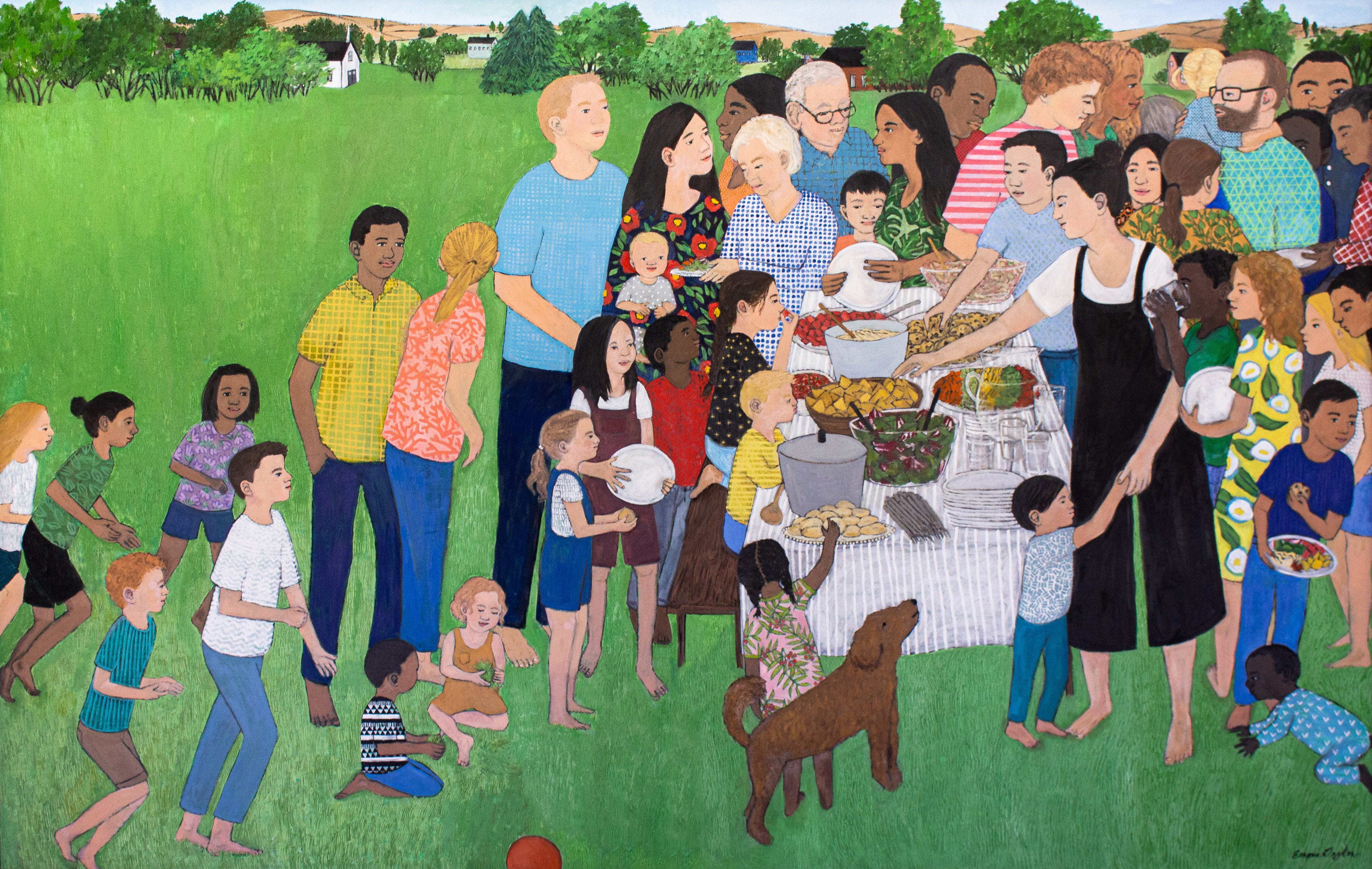
God can work miracles in my life.
And while most of us will not become prophets like Elijah or Elisha, we are all asked to do remarkable things. Raise children, help the poor, bless the needy. We are asked to solve problems we don’t know how to solve — big problems — things like hunger, and poverty, and depression, and sorrow, and pain. And we will fail. And our prayers will go unanswered. And when this happens to you, maybe all you will be able to say is: “God, I’m here trying. Where are you?”
And when you say this, the water may not part, the dead might not rise, and you might never have a chariot escort you to heaven. But what you will do will be no less remarkable. And you will learn that, with God, you are every bit as amazing as you ever could have imagined. And so don’t wish you were like someone else. Don’t fear humiliation. Go out and try your best. And with God, you will perform miracles, your miracles, miracles no one can do but you.


And yet, we have been counseled to seek and expect miracles. By definition, a miracle is improbable and inexplicable. Logic tells us a fallen bird in a ditch cannot fly again, but hope transcends logic. “Hope is a living gift, a gift that grows as we increase our faith in Jesus Christ,” Elder Neil L. Andersen taught. Reframing hope as a gift, a divine bestowal, rather than something we have to muster ourselves from depths of personal and global struggles, makes hope seem possible. Sometimes praying for the miracle I yearn for feels like too far a leap, but I have no reservations over asking for hope—a single dandelion of brightness in the expanse of heaven’s garden of gift.
In mortality, hope often comes as a reorientation rather than a remaking—the ability to refocus on light rather than shadow. Jesus’s disciples did not escape the oppression of Roman rule or find liberation from poverty. While some experienced miraculous healings, those who followed Him were asked to give up things they loved. Many of them were executed or endured illness and imprisonment. Yet Paul proclaimed that “hope maketh not ashamed.” Peter asserted that Jesus Christ gave us all a reason for “lively hope.” Nephi encouraged followers of Christ to have a “perfect brightness of hope.” King Lamoni’s wife stubbornly insisted that while her husband showed every indication of death, he still lived. These faithful disciples’ circumstances had not been remade yet, but their eyes were turned to the Light, certain that through Christ, every shadow would one day be swallowed up.
—Loren Lemmons, “Dirty-Feathered Hope”
There was nothing fundamentally magic about how I ended up where I did that summer. In that way, maybe this was all bound to happen to someone at some point. But it didn’t just happen to someone. It happened to me. It happened right as I was on the cusp of deciding, at least in broad strokes, what the rest of my life would look like. It happened just ahead of the lowest point of my life. Being on the receiving end of so many unlikely though explainable coincidences makes me feel strangely connected to those pioneers who looked into the face of uncertainty and remained resolute. Like them, there was a miracle when I needed it. A miracle, it seems.
—Dominic Shaw, “A Miracle, It Seems”
The Lord will fulfill His words given through His prophets.
As modeled by Joseph, we Latter-day Saints are called upon to be active participants in shaping the outcome of prophecies. Where prophecy speaks of disasters, we are not, like Jonah, to hope for its fulfillment; we are, rather, called to help avert those disasters, as Jonah did inadvertently. Where prophecy speaks of hopes ahead, we are called to be coworkers with God in actualizing them. Scripture is a script. Reading it actively opens us to performing its best lines and avoiding its worst.
—Don Bradley, “Hope, Fear, & Creation”
…The biblical prophet succeeds not by predicting the future accurately but by creating possibilities for people to change it. This insight cuts against everything our data-driven age believes about wisdom and authority. We worship at the altar of prediction: algorithms that forecast consumer behavior, models that anticipate market movements, analytics that promise to reveal hidden patterns in human conduct. But the prophet operates by entirely different logic.
Jonah, history’s most reluctant oracle, proves the point. God dispatches him to Nineveh with words that sound like inevitable doom: “Forty days, and Nineveh shall be overthrown” (Jonah 3:4, JPS). Jonah delivers the message with all the enthusiasm of a man reading his own death warrant. The city erupts in repentance—sackcloth, ashes, fasting. Nineveh survives.
By every contemporary measure of expertise, Jonah failed spectacularly. His prediction proved false. His credibility lay in ruins. Yet this “failure” represents prophetic success at its most sublime. The prediction failed because it succeeded—not as forecast but as catalyst. Jonah’s words didn’t describe an inevitable future but awakened a dormant capacity for change.
This reveals prophecy’s central tension. The prophet speaks about the future precisely to prevent it from happening. Prophetic speech creates space for humanity to turn around, to come home to itself, to become what it was meant to be rather than what it seems destined to become.
…The fortune teller fills tomorrow with magical necessity—what will be will be. The prophet fills today with transformative possibility—what could be if you change.
—Zohar Atkins, “Through the Strait Gate”
Maybe prophecy is more like seismology than like a weather report. I think that Joseph had sensed a fault line in his society, one that ran too deep to be healed by one clever compromise. And if the earth hadn’t shaken yet? He could still feel the pressure building beneath the surface.
… Once I drew lines between predictions and events like a game of connect-the-dots. But I no longer think about prophetic language as having a one-to-one correspondence between forecast and fulfillment. Now I imagine that prophets glimpse the future at times because they recognize the patterns beneath the surface of history. They see time in shadows and types. Maybe history is like a cloth being folded back and forth over underlying forms. Or maybe it’s like music. When we listen to a musical note, we’re not hearing a single pitch. We also hear overtones, a series of higher pitches with frequencies that resonate with the fundamental tone. Maybe prophets hear the music of the world better than we do.
—James Goldberg, “The Spirit of Prophecy”
…It profoundly matters how we read prophecy. If we always look behind and ahead—hunt for signs, decode symbols, and crowdsource interpretations to prop up corrupted power—we risk missing what the prophets actually do.
Aware of this shadow, we can hold their foretelling voice with cautious discernment, while also seeking their primary voice—their forthtelling voice. Here, we may find the prophets less interested in predicting the distant future than in confronting the urgent present. Less concerned with deterministic timelines, prophetic poets and protestors name what is broken and demand it be set right. Their words don’t just point forward; they cut deep into the now.
…Prophetic warnings carry a predictive edge—not to foreclose the future, but to shake people awake to their present path.
…Short-term foresight—like Joseph warning Pharaoh of famine, or Jonah confronting Nineveh—can sharpen our awareness of patterns we’ve ignored, alert us to the consequences of injustice, and call us to prepare, to change, to act. These aren’t weather forecasts—they are invitations to moral reckoning.
Then there’s the long view. A kind of predictive prophecy that stretches beyond the immediate, not to chart dates but to anchor hope. It’s what Dr. King invoked when he said, “The arc of the moral universe is long, but it bends toward justice.” That’s not prediction for its own sake—it’s vision. It’s the sacred conviction that God is not absent from history. That goodness outlasts evil. That Jesus is not just behind us in history, but ahead of us in love.
That kind of foretelling doesn’t excuse us from the work—it calls us into it, just as forthtelling does. Here, the two prophetic voices merge, giving us courage to build even when the arc seems impossibly long. And this is the point: prophecy demands our morality; it endows hope. The suffering of the dreamers—whether Joseph in the pit, Jesus on the cross, early Saints on the plains, King on the balcony, or us in our darkest nights—is not the end of the story.
We rise. We echo.
We bend the arc forward.
—Hannah Crowther, “The Forthtelling Voice”


As I am humble and obedient, Jesus Christ can heal me.
And today, we still don’t know her name. But if we did, we would remember it like we remember Sarah, or Rachel, or Mary. We’d remember the girl whose life was not good, but who did good anyway. The child who showed kindness even when the world was not kind to her. The person who saved her oppressor.
And because of her, we know that people can be gentle, compassionate, and loving even in the most terrible situations. And we can hope that Naaman was true to his word and worshiped God. Because then he’d have learned to see the people around him as equals. Not slaves or foreigners or enemies. And if he was able to do that, then maybe this girl’s kindness was reflected back.
But the fate of the girl does not rely on Naaman’s word or his wealth or his devotion or anyone else. Because the world turns on. More people die of leprosy. More wars are fought. More children are snatched from their homes. More families are shattered. Suffering continues throughout the earth. And despite it, the oppressed write their own stories. They make their own choices, live their own lives, and find their own freedom. And sometimes, they choose to end the cycles of violence. Sometimes, instead of revenge, they choose mercy. They show love instead of hate. They find a way to be gentle and meek. And because of them, there is so much less suffering in this world than there otherwise might have been. And though that might not cure leprosy, it is the greater miracle.


“They that be with us are more than they that be with them.”
For only a few times in history have armies put down their swords and differences and met like this. And each time it was a miracle.
And each time it was a revelation. A realization. A chance to see the world more accurately. That there are precious few bad guys. And that doesn’t mean there aren’t wars or death or tragedy or crimes or suffering. That’s all real. But so is this. There are many, many, many, many more good people in this world than bad ones. There are more people for us than against us. There is more love than hate. More caring than indifference. More humanity than its opposite.
And this will not always seem true. At times, it will seem like nobody cares, or people are selfish and cruel. And when you feel this way, look again. It’s not that you’re wrong. It’s just that there’s something else too. Heat waves rising over the kettle. A soft light, a mirage, a silvery something. And if you look, you will see them. The terrified soldiers, the golden angels, the enemy, the friend. In the end, they are all part of us. And though we might not know it yet, we are fighting for each other.


Sometimes in the Church we like to think of ourselves as special or different. I remember learning very early that we are a peculiar people. We are blessed with knowledge, while “the World” sits in darkness. They need us to bring them the truth, to help them change their ways. We are the ones who have something to offer Them. But when I read Christ’s story of the Good Samaritan, I see something different. I see the importance of an outsider perspective. I see an other who has something to give. Maybe we aren’t the only peculiar people. Maybe heaven and earth are both populated by scores of peculiar peoples, each treasured by God, each with special callings that have been informed by their talents, skills, and cultures.
—Jeanine Bee, “Peculiar Peoples”