

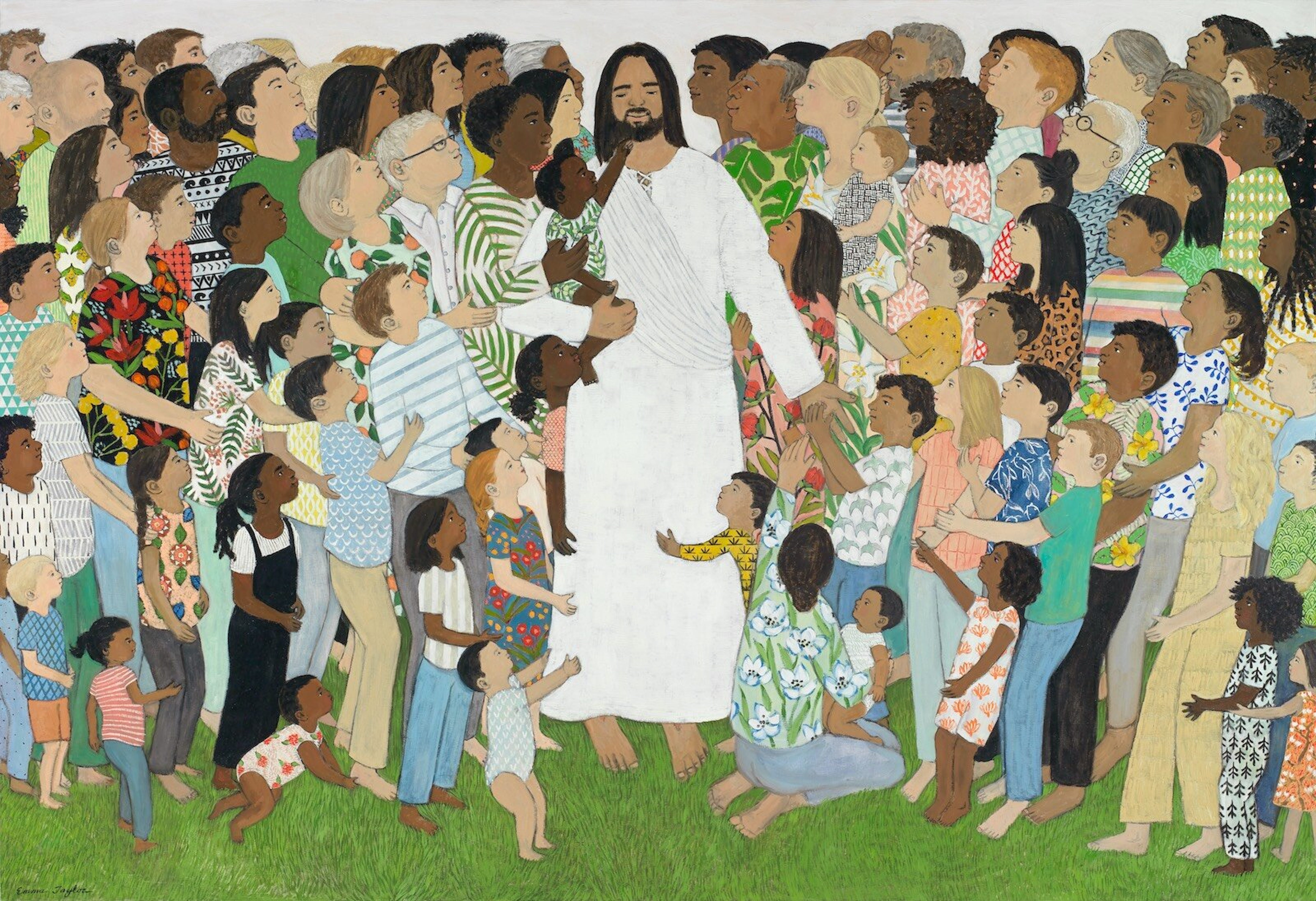
The Lord’s covenant people are a treasure to Him.
The greatest heresy in the history of monotheism is a misunderstanding of chosen-ness. It is the assumption that some are chosen for exclusive privilege, when in fact to be chosen by God is to be chosen for loving service. …
There’s this set of dynamic tensions that God says to Abraham. God says, I’ve chosen you to bless you and to be a blessing. I will make you a great nation, but through you, all the nations of the world will be blessed. …
The blessing is not exclusive. It’s instrumental. And that sense of being chosen, that chosen-ness, doesn’t mean that I’m better than anybody else. It means I’ve been chosen because God loves everybody. I have the privilege of trying to be a channel of of God’s love, not to people I’m superior to or separated from, but to people who God loves too.
—Brian McLaren, “Life After Doom”

Sometimes in the Church we like to think of ourselves as special or different. I remember learning very early that we are a peculiar people. We are blessed with knowledge, while “the World” sits in darkness. They need us to bring them the truth, to help them change their ways. We are the ones who have something to offer Them. But when I read Christ’s story of the Good Samaritan, I see something different. I see the importance of an outsider perspective. I see an other who has something to give. Maybe we aren’t the only peculiar people. Maybe heaven and earth are both populated by scores of peculiar peoples, each treasured by God, each with special callings that have been informed by their talents, skills, and cultures.
—Jeanine Bee, “Peculiar Peoples”

When we equate chosenness with deserved blessings, we create a dichotomy where those who aren’t chosen “don’t deserve” blessings. Fatimah Salleh and Margaret Olsen Hemming, authors of The Book of Mormon for the Least of These, reinforce this conclusion, arguing that chosenness can be “highly problematic in scripture and theology.” They add, “for if there is a chosen then there must be an unchosen. Any theology that would bifurcate and divide God’s children into the favored and unfavored can be a destructive and harmful mindset.” This way of thinking can breed dualistic, hierarchical relationships, leading to delineations of worthiness and unworthiness and potential discrimination in a divided society. Interpreting blessings or prosperity in terms of chosenness disrupts the chance for the beloved community that God is offering as the promise in the land.
…
Ultimately, Christ himself modeled the rejection of privileged prosperity in an act of self-emptying on the cross. As Latter-day Saints, we must courageously dismantle any false notions of deserved prosperity and power, for there is “no real imitation of Christ without humility, poverty of spirit, austerity of life, and genuine charity.”
—Jenny Richards, “The Promised Land”
…While this rabbi was only tangentially speaking about covenants, he reframed them for me. He said that he was sometimes asked by people who were not Jewish, “What makes you so special?” The implication was, “What gives you the arrogance to call yourselves a chosen people?” Latter-day Saints could ask themselves this same question: among the billions of people who have lived on earth, why would God give this unique piece of saving information to just a few favorites? Who made us the teacher’s pet?
The rabbi’s response to this question was simple: God chooses those who choose Him.
This felt like a mic drop moment. It was so basic. Could it be that this was the essence of covenant? Fundamentally, it’s not about reciprocal duties, but rather, reciprocal relationship?
And could it be that at the heart of every covenant we make is this one same truth? It’s not just separate and distinct agreements made at baptism, during the sacrament, and in the temple. It’s not a legal contract with pages of clauses. It’s one promise. It’s one choice. It’s saying yes to gracing. Fundamentally, it’s not making covenants (plural), it’s living in covenant (singular). It’s living in Christ.
—Hannah Crowther, Gracing
Sacred experiences require preparation.
If you—or someone you love—is preparing to receive their endowment for the first time, this episode of Sanctuary is for you:

Obedience to God’s commandments brings blessings. God gives me commandments because He wants me to be happy.

The ego certainly prefers a spirituality focused on certitude and transactional agreements with God over a spirituality that asks us to love one another in our shared uncertainty and suffering. Why wouldn’t we want control in a fallen world? Obeying the rules in exchange for security is a desire that certainly makes sense. Our impulse to find order and predictability in the midst of disorder and pain is both understandable and deeply human.
But as we endure life’s inevitable losses, our spirituality tends to become one of recognition—a spirituality that perceives the beauty and wonder in life amid the necessary sorrows and hardships. And though our souls can feel a deep order within reality—divine truths we are all subject to—we understand that faith doesn’t grant us certainty or obviate suffering. Rather, it offers us solace, evidence of God’s love in sublime moments, and glimpses of the eternal that anchor us in a world full of loss.
—Jennifer Finlayson-Fife, “Our Bodies Are Holy Things”
Making covenants shows my willingness to obey God’s law.

The action of participating in ordinance becomes a way of saying to our Heavenly Father, to the Savior, I want this, I want to be like Christ. We are ritually enacting a willingness. … The Germanic root of the English word, Wille, means to want. So “I’m willing,” says, “I want this.”
—Jennifer Lane in “An Embodied Discipleship,” an episode of Sanctuary
This is what I have learned about covenants: You can try for thirty years to keep the promises you made as a child, and have never kept a single one, not perfectly, not even close. You can sink deeper and deeper into an ocean of indebtedness. And yet that same sin and brokenness can save you. If you let it, your failure will force you straight back into the arms of Jesus. He stands above the water, reaching down to pull you up.
And hear this, my boy: You are not drowning. You are being baptized.
And when you stop trying to kick and thrash your way into heaven, you will realize that every bit of you from the tips of your toes to the hairs of your head are awash in the grace of Jesus Christ.
And so young as you are, flawed and proud and hungry and ambitious and imperfect as I have made you, be baptized. Fall backwards into promises so much deeper than your comprehension or abilities. Commit yourself again and again and again to the life of a disciple, the life of a friend and follower of Jesus. Plumb the depths of a relationship that has no bottom. Immerse yourself in covenants. And leave no piece of your soul above the surface.
—Sarah Perkins, “Covenants by Immersion”
Sin is turning away from God; repentance is turning toward Him and away from evil. I will not “turn aside” from God’s ways.
Repentance is the journey of turning to God again and again. We forget to join with God, and then we remember. We think we are right, and then we realize we are wrong. We stop living a lie. We stop telling ourselves stories that keep us stuck. We live with ego-driven, narrow vision, and then, as with a camera lens, we zoom out and see that God was present all along. Our experience and story changes. God offers alternate views, relationships, healings, and ways of being and seeing—over and over.
—Hannah Crowther, Gracing
The word repent in Hebrew is shuv and it simply means “to turn back.” And what am I turning back to? I’m turning back to Eden. We’re coming back to God’s presence. … Preach nothing but repentance. Preach nothing but turning back to God.
—Josh Matson, in “Insights from the Ancient Tabernacle,” an episode of Sanctuary
The Sabbath is a sign. Honoring the Sabbath is a sign of my love for the Lord.
I no longer used the Sabbath merely "to recharge my batteries” for the work week ahead, although recharging was a natural by-product. Instead, I began to use the other days of the week to live towards the Sabbath, where consciousness, gladness, and life had grown more keen. In my stricter rules for the day, I found not confinement but freedom. More precisely: By my chosen confinement (my letting go and fencing off of the mundane), I found myself unshackled from mundane preoccupations and their attendant anxieties.
—Philip Barlow, “Sacred Time”
Theologian Walter Brueggemann called the practice of sabbath an act of resistance. The word conjures French fighters, stylishly sabotaging Nazi infrastructure while smoking Gauloises. Imagining myself in a beret with red lipstick really helps when I attempt to turn off my phone for a day. It’s certainly a more attractive image than the grey, dull associations most of us carry. Sabbath sounds to us like the shop closing early just when we’ve run out of milk. It sounds like restriction. Which it is. But it is also through restriction, liberation.
For most of the week, my value is in what I produce and what I consume. If I’m not careful my main goal in a day becomes being impressive and competent, subtly signaling my status with the things I buy, say and post.
Sabbath is the opposite. It is a line in the sand. Today I am just a person, and a person is beyond price. Sabbath is about valuing, fighting for and fiercely guarding rest.
… For Jews and Christians, the sabbath is not designed to serve work, because love, not work, is our ultimate end. It always moves me that the sabbath command was given directly after the Exodus, to a nation that had until recently been enslaved for generations. There is a tenderness in mandating rest and play for traumatized people who had only ever known enforced labor.
Mandated time to rest seems a foreign notion now. It’s become one of the few clear political intuitions I have: that it shouldn’t be. Breaking time, and people, into ever flexible units of production is one of the strongest drivers of disconnection that we experience. I have come to see sabbath as central for my personal project of connection, with myself, with my family and community and with [God]. It’s a relational reset every week, a bulwark against the instrumentalization of relationships and the commodification of time.
—Elizabeth Oldfield, “Attending to Life”
What was the difference between the two sets of stone tables Moses made?
God's intention in revealing the law was to build a relationship with us, because God wants us close. God wants intimacy with us. So on the second trip up the mountain, God gave Moses a set of things to do that would build a sacred transactional relationship…
—Steve Young, “Two Trips up the Mountain”