

What can we learn from Creation? How do we honor Creation?
Faith Matters resources to accompany your Come Follow Me study: Jan 12-18


This business of creating is not what I originally thought. I used to picture Adam and Eve developing from the dust like some kind of abracadabra magic. I imagined creation from nothing, ex nihilo, in a specific place and time—be it 4000 BC in the Middle East or Adam-ondi-Ahman, or two million years ago in Africa. Whenever it happened, I imagined that afterwards, God wiped His hands, wrapped it all up, and then moved on to more pressing business.
No. It seems to me now that creation is more an ongoing tinkering project, a long discovery embedded in deep time—a gathering of available resources, a repurposing of the material of the world to build new forms and new bodies. It’s taken millennia for creative hands to pull together the stuff to fashion me and all my other fellow humans, not an instant. And rather than being finished, God is still in the work—a master chef, pulling from a little of this and a little of that, taking stock of ingredients from the nearby gardens, pantries, woods, and stores to add spice and flavor.
God is still creating bodies and spirits and me.
—Hannah Crowther, Gracing

“By mine Only Begotten I created these things.” Jesus created the earth.
For the ancient Jews, a very popular creation narrative in their part of the world would have been an Assyrian creation narrative that was about this ancient family of gods who were the only things that existed. And one was named Tiamat. And Tiamat was like a giant crocodile… and what happens is there’s a fight among this family of gods. And one of the gods, one of Tiamat’s sons, takes the top jaw and the bottom jaw and rips Tiamat in half. And one half of Tiamat becomes the earth and the other half of Tiamat becomes the sky, and the blood of Tiamat, the blood clots, are made into human beings.
Now, if you take that as your story, what does that say about the universe? The universe is about chaos. The universe is about conflict. The universe is about violence. And we are the product of chaos and violence. And that’s where we find ourselves. And I can see how that story would help people think, yeah this is a bloody messy world out there and we got thrown into the middle of it and it was bloody and messy before we got here and here we are trying to make our way through it.
Read the biblical story and what happens? It doesn’t start with a family of gods having fights, it starts with God saying let us make (there’s almost this sense of a community saying,) how about we make a beautiful earth, and it’s all good, and it’s all peaceful, nobody gets killed to make anything, there’s no bloodshed, the world is good.
Now if you just take that story, that Hebrew story, put it in conversation with the Assyrian story, I can see here’s how the Jewish people were taking the dominant story of their time and saying that story is not good enough. We need a better story than that.
—Brian McLaren, “Embracing and Challenging Scripture”
While scriptures generally focus on why the earth was created, we also learn from the restored accounts a few important things about how. As just one example, we read in the Book of Abraham that the Creation didn’t happen instantaneously or over a few short days, as many believers used to assume. We learn rather that our sense of time is quite different from the Lord’s and that the Creation took place over the course of a much longer period and in stages (see Abraham 3). This account is compatible with what we have learned from science about the age of the earth.
From the restored gospel’s creation account we learn that the earth was created out of unorganized matter. Our Creator is more a director of a symphony of life than a magician who pulls rabbits, rats, and rattlesnakes from his Creationist hat. His creative power lies in the capacity to partner continually with nature’s laws and with pre-existing chaos in order to make novelty and life possible. I believe this too resonates with what contemporary science tells us about how the universe and life on this planet have emerged.
—George Handley, “A New Story of Creation”
Telling a New Story of Earth's Creation - with George Handley and Jani Radebaugh

In this Faith Matters Big Questions conversation, Faith Matters team members Kate H. and Bill Turnbull speak with BYU humanities professor George Handley and planetary scientist and BYU professor Jani Radebaugh. They discuss, among other things, the integration of faith and science as pertaining to the earth and its creation, as well as our relationship to the earth and the responsibilities that we have to it as its stewards and as God’s children. We hope you enjoy this conversation!


In the beginning, we are told, God moved upon the face of the waters, divided light from darkness, brought forth herb-yielding seed, set lights in the heavens, and created great whales and winged fowl and every creeping thing, using atoms from stars as His medium. The whole process required as much aesthetic sense as technical ability. Eventually, God’s children were set on the earth, with their own charge to create.
Immersed in grace, God’s people would follow suit. Moses would create a people chosen by God out of a people who frequently forgot Him. Noah would create a refuge from the storm. Joseph of Egypt would create family reconciliation from estrangement. Esther would create a way to save her condemned people—as would Jesus. Isaiah would create prophetic poetry that would point to truth through all ages. And Peter and Paul would create community among a hodgepodge of Jews, Greeks, and Romans, all bound by a testimony of Jesus.
In my own sphere, I occasionally emulate my creative Heavenly Parents—the Ones who fashion their grand creations from grass, pond scum, and stars. Immersed in grace, I gather orange construction paper, green grapes, Jesus Christ lizards, and whatever else I can find, recycling and repurposing the stuff of my little universe. I create a meaningful life from a jumble of days—order from chaos, light from darkness, and beauty from ashes.
One day I hope to find it all on God’s fridge—and proclaim that it was good.
—Hannah Crowther, Gracing

I am created in the image of God. I was created in God’s image.
I see a different God in Joseph Smith’s revelations, one more similar to the God of Genesis, who says, “Let us create.” One commentator writes, “The ‘let us’ language refers to an image of God as a consultant of other divine beings…. Those who are not God are called to participate in this act of creation…. The ‘let us make’ thus implicitly extends to human beings, for they are created in the image of one who chooses to create in a way that shares power with others.”2
—Terryl Givens, “The Abounding Church”
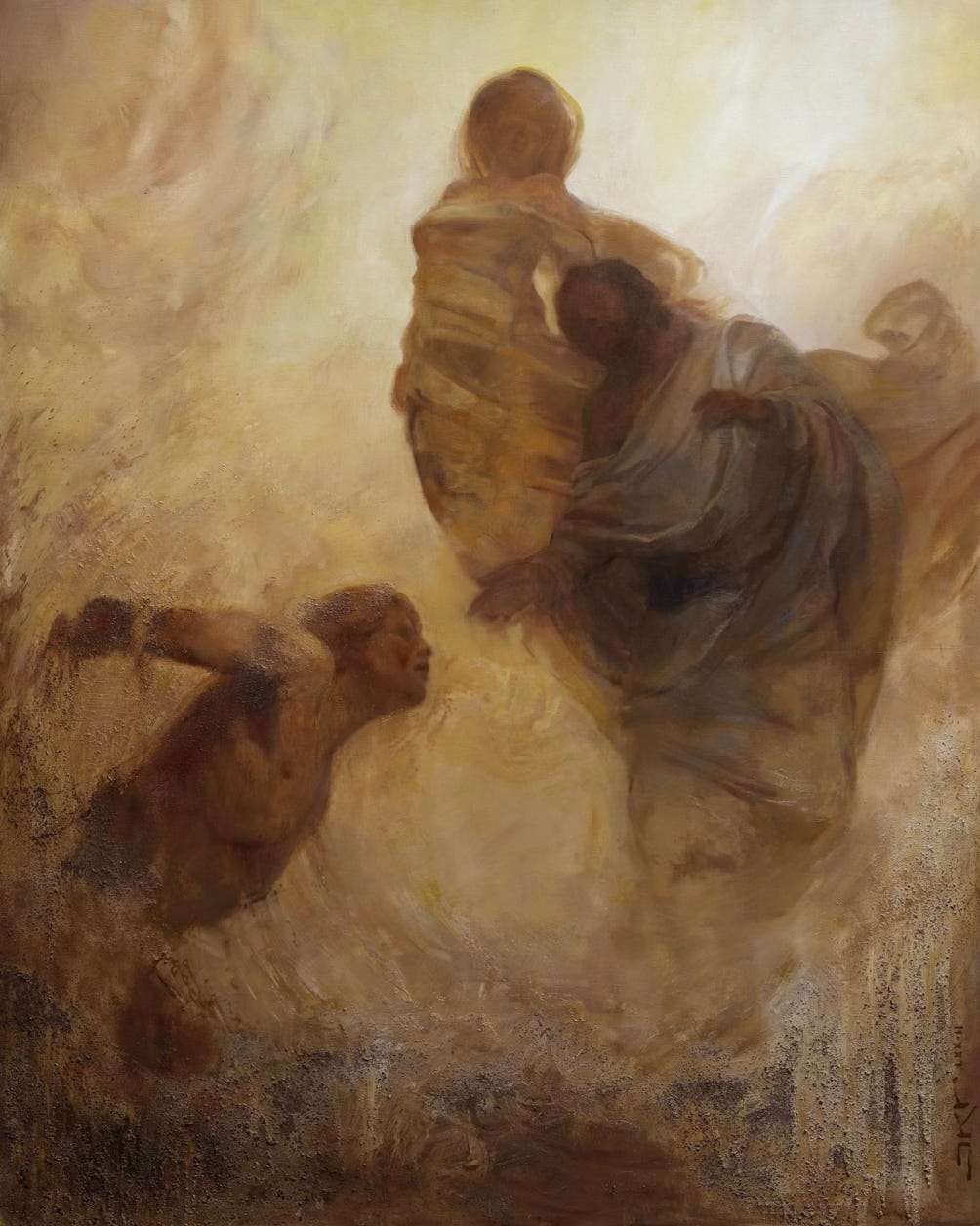
This was the first time I had seen the divine feminine, which is just another way of saying it was the first time I saw myself.
—Maddie Blonquist, “Reflections on “Breath of Life” by J. Kirk Richards”
Just as birds and dragonflies are filling the measure of their creation by sparkling with iridescence in the sun’s light, and just as stones and strings and bells are simply themselves by making the sounds of stones and strings and bells, human beings are who they are when they are themselves. And we are most ourselves when Christ is at play in us—when we show justice, embody grace, and manifest Christ through our actions and faces. Christ plays in ten thousand places, through all of creation.
—Hannah Crowther, Gracing
Knowing that I have a Heavenly Mother who looks like me, who has a body maybe not exactly like mine but pretty close to mine, with all the parts that I have, and that that’s good? … It creates confidence in me, and I don’t feel the same desire to hide. To know that the functions and the parts of my body are divine gives me more appreciation, and I think that for women knowing the goodness of their bodies and the goodness of their sexual response and being able to tie that to our divine mother, that’s really powerful.
—Bonnie Young, “Sex Educated”

As children of endlessly creative Heavenly Parents, we have a birthright—the divine gift of creativity baked into our bones. Our creative possibilities, as Dieter F. Uchtdorf explained, include not just any talents that can be displayed on “a canvas or a sheet of paper.” They do not solely require “a brush, a pen, or the keys of a piano.” Rather, “creation means bringing into existence something that did not exist before—colorful gardens, harmonious homes, family memories, flowing laughter.” It’s delving into the chaos, again and again, to bring shape and meaning to whatever is without form and void.
—Hannah Crowther, Gracing
Marriage between a man and a woman is ordained of God.
In the beginning of the book of Genesis, at the end of each day of creation, God pauses and reflects on what has been created in that day and then remarks that it was good, that it’s good, it’s good, it’s good, it’s very good.
And the first thing in the Hebrew Bible that’s not good is, it’s not good for a person to be alone. And actually, there are only two times in the whole five books of Moses where something is explicitly called not good. The other time that something’s called not good is when Yitro or Jethro, the father-in-law of Moses, tells Moses that it’s not good for him to try to adjudicate all of the laws on his own. So again, it’s aloneness or separating yourself from the community that’s considered to be not good.
And so the response to the awareness of how not good it is for Adam Ha-Rishon, this first person, to be alone, is of course the creation of a partner for Adam and that partner of course is Eve. And there’s this incredible Midrash, this rabbinic tradition, that tells the story about the creation of Eve.
First, the idea from the rabbis is that actually the first being was not male or female, but actually was this one being that had everything contained in one, but was lonely, and actually had two faces. There’s some artistic representations of this that maybe you’ve seen, but had two faces, both facing outward, but they couldn’t turn toward each other.
The idea that the rabbis put forward is that that being actually had to be cut in half so that they could turn and find each other, and turn toward one another with love and with tenderness and with care.
So at the end of the sixth day of creation, which was the first day that human beings were alive in the world, the sun starts to set, and the sun has never set before for these people. It’s the first day of their lives. And so they’ve never seen darkness before. And Adam starts to get really worried and he starts to weep. And then it gets darker and darker and darker as the sun’s going down and he starts to wail. And then he starts to scream. He’s really scared and he thinks that the whole world’s going to end and that it’s his fault. He must have done something wrong. And Eve comes to Adam and sits across from him. K’negedlo, it says, just sits right across from him, and holds him and weeps with him through the dark of night. She doesn’t try to make it better for him. She doesn’t say, no, it’s not your fault, or, I promise you, you’re going to get through this, because she doesn’t know either. She’s also never seen the darkness like this. But she can assure him with her presence that she will be with him as long as the darkness lasts. And then together, they welcome the new dawn when it arises.
And I really read in this the idea that one of the most important questions that we can ask in life is, who will sit and weep with us through the dark night of the soul? Who’s willing to be with us, not just on the good days, but really through the hard times too? And not to fix us, and not to give us certainties and assure us that everything’s going to be fine, but to just be in the discomfort with us, to sit in the grief with us and to help hold us just with love and care until we are able to move to the next chapter?
—Rabbi Sharon Brous, “The Amen Effect”


I am responsible for caring for God’s creations.

Beyond being simply a scientific or political necessity, the care of the earth and of our natural environment is a sacred responsibility entrusted to us by God, which should fill us with a deep sense of duty and humility. It is also an integral component of our discipleship.
—Elder Gérald Caussé, “Our Earthly Stewardship”

In these restored accounts of the Creation, we also read that there is a spiritual creation before a physical creation, making not just human beings but all plants and animals “living souls” (Moses 3:19). When we interact with plant and animal life, in other words, we are dealing with physical forms that radiate intelligence and light– God’s glory. Plants and animals are our biological and spiritual kin. Latter-day Saint understanding of the Creation, in other words, grants unusual spiritual identity and transcendent meaning to physical life.
… The history of the world records that exploitation of the earth creates and exacerbates inequality among God’s children. This is why we have such a strong mandate to use natural resources with “judgment, not to excess, neither by extortion” (see D&C 59:20) and to avoid waste so as to ensure more equitable distribution of resources (see D&C 49: 20-21). These stewardship principles are beautifully outlined and described in recent talks by Elder Steven E. Snow and Elder Marcus B. Nash. Thankfully, the Church has placed renewed emphasis on these principles, and lay members have begun to celebrate these doctrines so vital for the 21st century.
Stewardship is a way to acknowledge our own creation and our own obligation to participate responsibly in God’s ongoing creation and thereby learn to become creators ourselves.
—George Handley, “A New Story of Creation”

Can Creation Heal Us? — Terryl Givens and George Handley

The first chapter of Genesis says: “In the beginning, God said let there be light, and there was light.” God created this extraordinary world, the scriptures tell us, through the power of his Word.
In this conversation, George speaks with Terryl about connecting with the divine through nature, about being a good steward of the earth; about the tragic death of his brother; and the history of a river.

God blessed and sanctified the Sabbath day. The Sabbath day is holy.
God created the world in six days and saw that it was good, and on the seventh day He rested. God blessed the day and made it holy. God’s children are commanded to hallow the Sabbath day— meaning to make it holy, to consecrate or sanctify it. We are to set it apart for rest. …
The rabbi Abraham Joshua Heschel writes of the Sabbath not simply as a day without something, but with something. Toil is replaced with an almost tangible holiness. The Sabbath, he writes, “is a day for the sake of life. Man is not a beast of burden, and the Sabbath is not for the purpose of enhancing the efficiency of his work. . . . It is not an interlude but the climax of living.” In other words, it’s not a means to an end but an end in itself.
Other religions have places of holiness—temples, cathedrals, and mosques. But Heschel says that for the Jews who were scattered and without a home for so long, holiness was created with cathedrals of time. This set-apart time has an aura of holiness.
He writes, Unless one learns how to relish the taste of Sabbath while still in this world, unless one is initiated in the appreciation of eternal life, one will be unable to enjoy the taste of eternity in the world to come. Sad is the lot of him who arrives inexperienced and when led to heaven has no power to perceive the beauty of the Sabbath.
It’s as if Heschel learned to welcome the restful paradise of heaven into an earthly day and to see the Sabbath as a harbinger of eternity.
—Hannah Crowther, Gracing
For most of the week, my value is in what I produce and what I consume. If I’m not careful my main goal in a day becomes being impressive and competent, subtly signaling my status with the things I buy, say and post.
Sabbath is the opposite. It is a line in the sand. Today I am just a person, and a person is beyond price. Sabbath is about valuing, fighting for and fiercely guarding rest.
… I have come to see sabbath as central for my personal project of connection, with myself, with my family and community and with [God]. It’s a relational reset every week, a bulwark against the instrumentalization of relationships and the commodification of time.
And rest is, fundamentally, about being human. About recognizing our limits when advertising tells us we are limitless. It requires intention, and working out what we do actually find restorative. … Proper rhythms of real rest rather than passive leisure consumption make focus easier when we need to work, make it more likely we will find joy and flow in it when we do.
—Elizabeth Oldfield, “Attending to Life”

