

Seeing Clearly by Looking upon the Heart
Faith Matters resources to accompany your Come Follow Me study: June 8-14
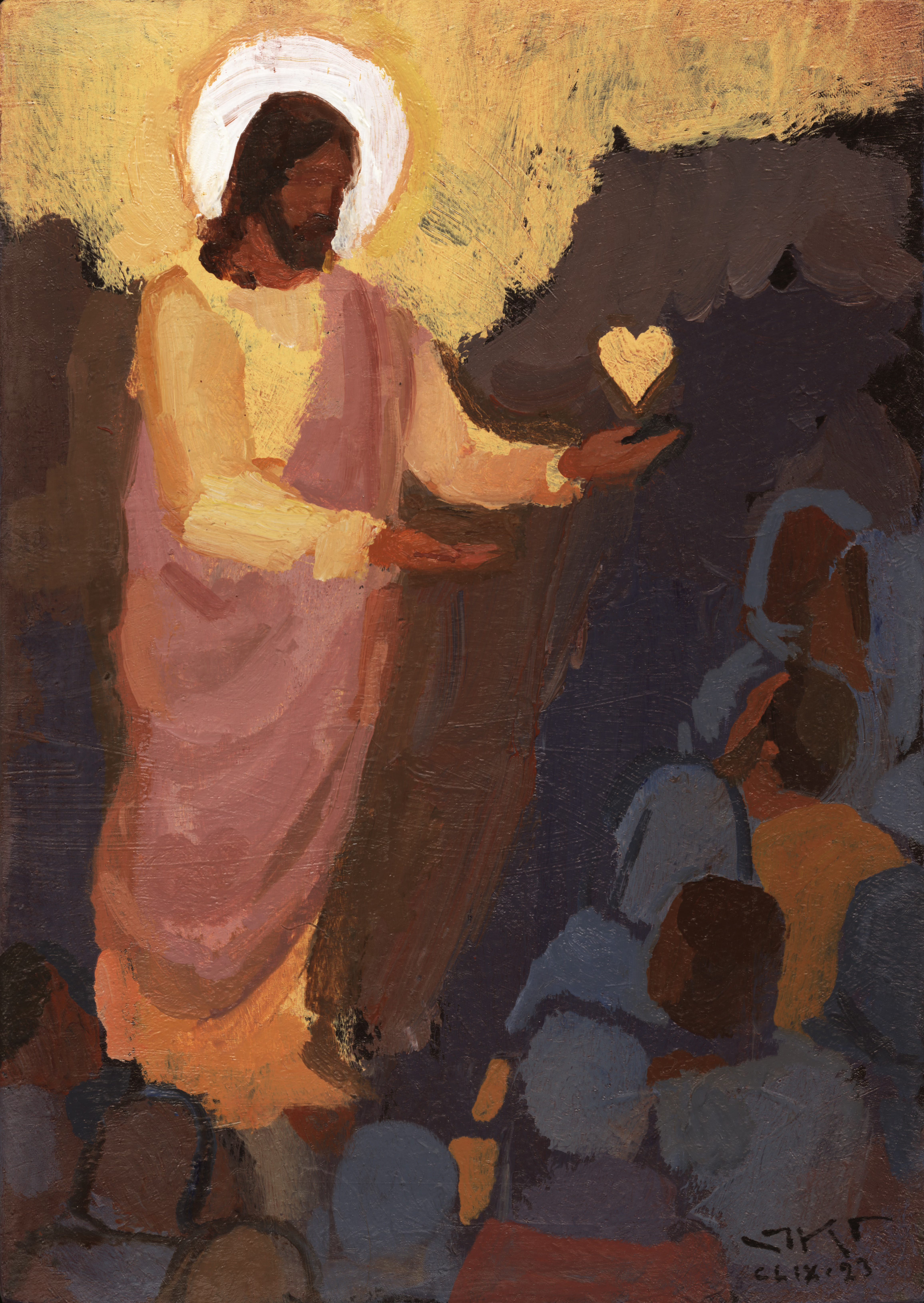
Jesus Christ is my King.
Straight out of the wilderness, before anything else, Jesus preaches the good news of the kingdom of God — a kingdom that, contrasted with the kingdom of Augustus, blesses the meek, the merciful, the hungry, the poor, and the powerless.
—Jon Ogden, “Finding the Gospel by Seeing Differently”
As Latter-day Saints, we believe that we will build Zion by consecrating ordinary things to the Kingdom of God—including our ordinary selves. The Kingdom is not a holy place that we find or inherit. It is an ordinary place that we make holy through our constant attention to the purpose of our existence. Our ordinary planet will become a paradise, and ordinary people will become like God. This, too, will be ordinary in the original sense of the word; it is the state of existence that has been ordained since the foundations of the world. The Zion we build will be the culmination of ordinariness, which will become a thing of great beauty and eternal wonder.
—Michael Austin, “Immanent Grace”
This is our origin story. We are a people who have been persecuted and mocked. But our response is not—cannot be—contempt. We were expelled from American society, and we wandered, and we built. Now, we have been called back to the society that cast us out—not to exact vengeance but to make peace, to share what our long exodus taught us about community building, forgiveness, and reconciliation.
We live in a moment when much of our public life runs on contempt. The measure of a political leader, these days, is often the fury he or she can generate against those who think differently. The Book of Mormon, read carefully, is in part a long warning about exactly this dynamic. It is the story of a people who let contempt harden into faction, faction into conflict, and conflict into collapse. And it holds out, as its most radiant counter-image, a society in which there were no “manner of -ites,” no contentions, and where “every man did deal justly one with another.”
Our apostolic leadership has named what is being asked of us. President Dallin H. Oaks, has called on us to “use the language and methods of peacemakers.” He has urged us to “moderate and unify” on contested issues, to “seek fairness for all,” and to resist the temptation to pursue total victory in our civic disputes. The historian Patrick Mason has observed that among all the Beatitudes, “Blessed are the peacemakers” is unique. The others describe conditions of the soul, but this one commands an action. President Russell M. Nelson taught us that “the Savior’s … true disciples build, lift, encourage, persuade and inspire. True disciples of Jesus Christ are peacemakers.”
—Thomas Griffith and Joshua Topham, “Our Origin Story”

God calls people by prophecy to serve in His kingdom.

In the restored Church, of course, I also associate the term prophet with the president of the Church. And I wouldn’t want to claim a presidential or priestly authority that is not mine. But even if we stuck to the verb and asked if I prophesy, I would balk. In English, to prophesy is not primarily to proclaim or to call. To prophesy is to pierce through time, echoing the future before it happens. …
I don’t know what the future has in store. Ask me what the world will be like in four, forty, or four hundred years and I’ll tell you I’m no prophet. But there’s more to prophecy than prediction. Ask me what my children and grandchildren might wrestle with and it’s different. I still don’t know. But I’ll crack my heart open to feel for the possibilities.
And maybe that’s the spirit of prophecy. A weighing of the world as it was, and as it is, and as it will likely continue to be. And a turn toward the One who carried everything.
—James Goldberg, “The Spirit of Prophecy”

Once I drew lines between predictions and events like a game of connect-the-dots. But I no longer think about prophetic language as having a one-to-one correspondence between forecast and fulfillment. Now I imagine that prophets glimpse the future at times because they recognize the patterns beneath the surface of history. They see time in shadows and types. Maybe history is like a cloth being folded back and forth over underlying forms. Or maybe it’s like music. When we listen to a musical note, we’re not hearing a single pitch. We also hear overtones, a series of higher pitches with frequencies that resonate with the fundamental tone. Maybe prophets hear the music of the world better than we do.
—James Goldberg, “The Spirit of Prophecy”
“To obey is better than sacrifice.”
There’s a difference between being obedient to eternal principles, and compliance and people pleasing… And so I think it’s important to tease out doing the right thing for the right reason, and doing what someone else tells me to do, even when there’s dissonance and it doesn’t actually feel right.
It’s really distinguishing between, what does God actually want, and what does this human being understand God to want? And that’s really tricky territory for all of us. And I absolutely believe that God wants us to grow through those kinds of situations. There’s a reason that there’s dissonance—that’s where we grow, and that’s how we become godly. That’s how we become divine is by those kinds of collisions.
I think it’s really a matter of why am I doing what I’m doing? Am I doing it because it’s in line with what I believe about God and how I understand eternal truth? Or am I doing it just to check the box or stay on the safe side and not step out of line of kind of human expectations or institutional expectations. At the end of the day, that’s a really personal thing that we each need to wrestle with and determine for ourselves.
I absolutely have a strong testimony of obedience and its value. And I see that as distinct from things like compliance and people pleasing or conforming to institutional expectations.
—Deidre Green, Learning to Trust Your Own Inspiration

Are we capable of choosing selflessness over survival, compassion over indifference, sacrifice over fear? Would love, courage, and friendship endure within us if the world around us collapsed into darkness?
In a magnificent general conference talk given in October 2000, President Dallin H. Oaks sought to answer this question. In his talk “The Challenge to Become,” he emphasized that faith isn’t simply about acquiring knowledge or holding testimony. It is a call to become; to have our nature, desires, thoughts, and actions changed, rather than simply add information.
“It is not enough for anyone just to go through the motions. The commandments, ordinances, and covenants of the gospel are not a list of deposits required to be made in some heavenly account. The gospel of Jesus Christ is a plan that shows us how to become what our Heavenly Father desires us to become.” …
This sobering truth challenges the notion that we can simply “go through the motions” of religious life, reciting prayers without feeling, giving charity without empathy, or observing the Sabbath day without inner rest. We reject such superficiality; ours are not religions of heavenly bookkeeping, where commandments are deposits in a cosmic account. Instead, the commandments form a divine roadmap, guiding us toward our highest potential. They are the blueprint for refining our essence, polishing away impurities like selfishness, anger, or indifference, until we shine with the light of holiness.
—Jarrod Grover, “Becoming the Heart God Desires”

I believe there is an innate and even sacred desire within each of us to discover our own deep wells of passion, creativity, and self-determination. When we see obedience as the path toward conformity, it remains a perpetual struggle for self-mastery. If we see it instead as the freedom to truly love him as we are loved, it becomes the path toward fuller self-realization. Obedience does not gain us more love from God, but rather more power from his love to free us to do the good in the world we were born to do.
—George B. Handley, “Obedience as Gratitude”

“The Lord looketh on the heart.”
On the surface (in the kingdom of men) the poor and the meek have failed, and small things like sparrows, lilies, a pinch of yeast, and mustard seeds are essentially worthless. But in the kingdom of God, beyond the surface, these small things have tremendous worth and potential.
To change your mind—to repent—is to see this worth and potential. It is to see that everyone is a child of God. It’s to see a world where each person is deserving of forgiveness, a world where even our enemies are worthy of love, a world where we have the capacity to extend grace to all people just as God lovingly sends rain and sun on all people. This is the good news of the kingdom, a kingdom where, unlike the gospel of Augustus, everyone is a brother and a sister, independent of worldly status.
—Jon Ogden, “Finding the Gospel by Seeing Differently”

Poisonous political rhetoric, no matter whence it comes or where it is directed, deserves such strenuous resistance because it suggests an idea that is not true. We cannot be divided into good people and bad. We are, all of us, deeply flawed, complex and contradictory. Most of us try most of the time to get things right, and most often fail to get things right, at least completely, because that is the nature of living in a complex, flawed, and fallen world. But if our membership in the Church of Jesus Christ of Latter-day Saints can help to remind us that everyone we encounter in every circumstance—as well as each of the nameless and faceless people who make up the statistics with which politics so often deals—are literal children of celestial parents, then our beliefs can transform our political behavior. They can help us in this arena, too, to try to be more like Jesus. And that, at the end of the day, is what we are always called—and have covenanted—to do.
—Tyler Johnson, “From Contempt to Affection”


