

How can I inspire others to believe in God?
Faith Matters resources to accompany your Come Follow Me study: May 25-31
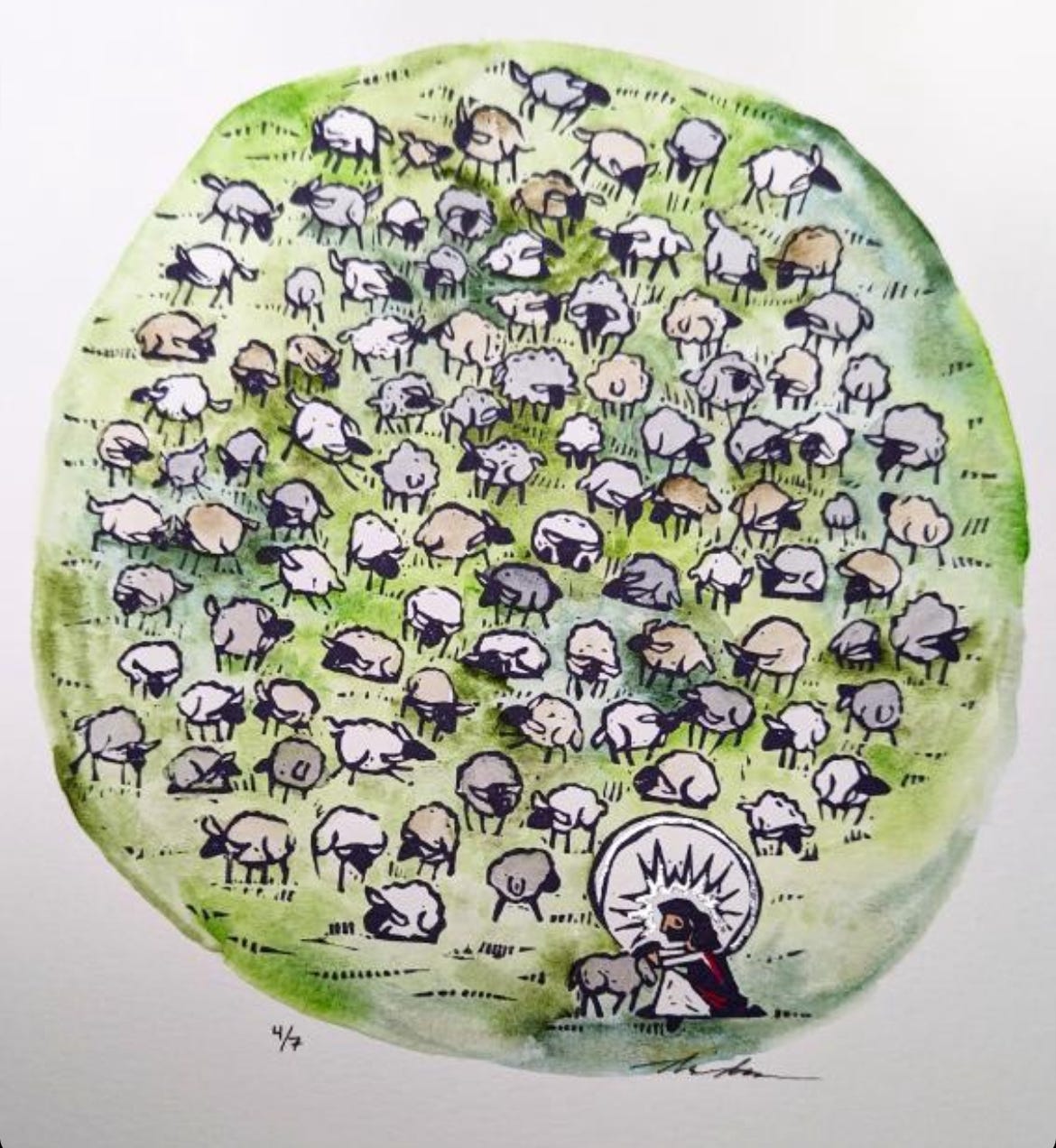
The Lord forgives as often as I repent.
In his essay Deep Unmet Needs, Lindon Robison explores the way we respond to our needs, and how sin can be seen as “springing from unmet needs.” He uses the people in Judges to showcase that springing from our need to belong:
There are two ways we satisfy our need to belong: by fitting in or by finding our community.
Fitting in
To fit into a community, we adopt the values, customs, traditions, and objects of worship of the group we wish to join. To fit in, the children of Israel abandoned the God of Abraham, Isaac, and Jacob, and worshiped other gods including Baal, Ashtaroth (Judges 2:12-13), the gods worshiped in Syria, Sidon and Moab, and the gods of the Ammonites and Philistines (Judges 10:6).
Belonging
Paul taught us not to “conform to the world” (Romans 12:2). Instead, we need to find a community where our ideal self feels at home, where we feel accepted for who we are. In the early church, some Jewish sects insisted that Gentile converts fit in by following the Mosaic law that required them to be circumcised. In contrast, Paul taught that belonging to Christ’s church, converts needed an inward circumcision of the heart, something they had already experienced (Romans 2:27-29).
You can also listen to “Repentance as Transformation,” a conversation between Thomas McConkie and Adam Miller on the Faith Matters podcast:

This is repentance as something like a positive way of life, rather than an occasionally negative thing that I have to do in response to my own failures. This is repentance as a kind of a proactive, positive cultivation of this open heart, that allows me to continually go beyond the limits of my own mind and my own soul. —Adam Miller
And listen to “Stories and Sin: A Conversation with Adam Miller,” which includes a question about how to help our kids develop a healthy relationship with these concepts:

If my experience of guilt fixes my attention even more firmly on myself, then I’m in trouble. If my experience of guilt turns my attention away from me and towards the people who I feel guilty about having hurt, then it’s working in the right way. It’s turning me in the right direction. —Adam Miller
God stands evermore at the door and knocks, even to “battering our heart,” in John Donne’s words.4 Yet until our heart softens, we can never expose that stony heart to that which “gives life to all things.” Spiritual death is self-imposed. In light of this litany emphasizing ourselves rather than God as the source of alienation and pain, the hardening of our own hearts—through self-loathing, disappointment, shame or guilt or stubbornness—the word repent carries new valence. It is not about “doing penance,” as the term was translated in the Latin Bible that had the monopoly on Christian understanding for 1500 years. The point is, “change your heart,” “melt those walls of iron,” “open the doors to forgiveness,” “let my love in.”
—Terryl Givens, “The Shock of Love”
I can inspire others to have faith in the Lord.
Consider the prophet’s teaching that God does not condemn someone simply because of their religious affiliation and that all will be judged according to the light and knowledge available to them. Rather than feel relief that this can serve as a “Get-Out-of-Missionary-Conversation-Free Card,” what if we offered this knowledge to the world? …
Though the gospel teaches there is one way to eternal life, the restoration expands access to that way. Every other road can eventually intersect with the strait and narrow path that leads to life, giving every child of God the opportunity to reach salvation. This knowledge means we do not need to condemn others with our warning voice, but it also does not need to pacify us into silence. Instead, it can motivate us to shout for joy as we share this mercy with everyone.
—Bryan Gentry, “Do All Roads Lead to Winnemucca?”


How can women specifically inspire others? Learn from these podcast conversations:


The Lord can work miracles when I trust in His ways. The Lord can use small things to do great work.
In his essay Tuned to the Covenant, Ryan A Davis explores the story of Gideon and his men at the well of Harod:
As a literature professor, I can’t help but notice in the story a narrative urge to induce a sense of wonder at the miraculous power of God, to remind Gideon that “with God all things are possible” (Matt. 19:26, NIV). I mean, what sane person would look at an opposing army described as “thick as locusts” (Judg. 6:5, NRSV) and think a force of 300 soldiers sufficient to engage? As scriptural passages go, Judges 7 is an impressive hold-my-root-beer moment precisely because God’s ways are not ours, nor are ours his (see Isaiah 55:8). So the arithmetic logic of the story is by design; the culling of the soldiers is part of the plot. We read in anticipation of the outcome of their story, just as they must have waited—perhaps with anxious faith—for the Lord to reveal the wisdom of his strategy. When they vanquish the Midianites, their faith confirmed, the narrative tension resolves. Their success no doubt brought them relief; it also provides us the psychological closure so central to the structure of stories. Thus through the magic of narrative, we are made (or at least invited) to jointly, if not coincidentally, marvel with Gideon and his soldiers at the wisdom of the Lord’s curious and counterintuitive ways.
And yet, there is a detail in the story that remains cryptic despite playing an important narrative function. If Gideon was meant to understand that without God there was no hope, and if we as readers are meant to marvel at God’s ability to work mighty miracles with a less-than-mighty force, then why did God instruct Gideon to select those soldiers who “drank from cupped hands, lapping like dogs” instead of those who “got down on their knees to drink” (Judg. 7:5, NIV)? What is it about the knee-drinkers that disqualifies them, and what makes those who lap like dogs fit for Gideon’s force?
It wasn’t until I learned about the bi-hemispheric brain of birds that my confusion began to dissipate, replaced by greater light and knowledge…
Leap of Faith: Mauli Bonner at Restore 2024

In this session, Mauli shares a wild, personal story that starts with a quiet spiritual prompting and ends with an act of radical trust that left the entire room stunned. He offers a moving look at what it really means to live a faith-filled life—one that’s non-transactional, that doesn't guarantee we’ll see the fruit of our actions, but that still says yes to being God’s hands.

God strengthens me as I am faithful to my covenants. Keeping covenants gives me strength.
Find everything we’ve published in Wayfare about covenants here
In a very real sense, then, the covenant path that beckons is a path of covenant attunement. For Gideon’s men, it was bifurcated attunement to the enemy and the water; for me, the managerial tasks of a bishopric and the miracle of sacrament meeting. Whatever the specifics of the covenant path look like for us individually, to walk it is to walk in “that light [that] groweth brighter and brighter until the perfect day” (D&C 50:24).
- Ryan A Davis, “Tuned to the Covenant”
Could it be that this was the essence of covenant? Fundamentally, it’s not about reciprocal duties, but rather, reciprocal relationship?
And could it be that at the heart of every covenant we make is this one same truth? It’s not just separate and distinct agreements made at baptism, during the sacrament, and in the temple. It’s not a legal contract with pages of clauses. It’s one promise. It’s one choice. It’s saying yes to gracing. Fundamentally, it’s not making covenants (plural), it’s living in covenant (singular). It’s living in Christ.
—Hannah Crowther, “Dancing With Christ” (an excerpt from Gracing)
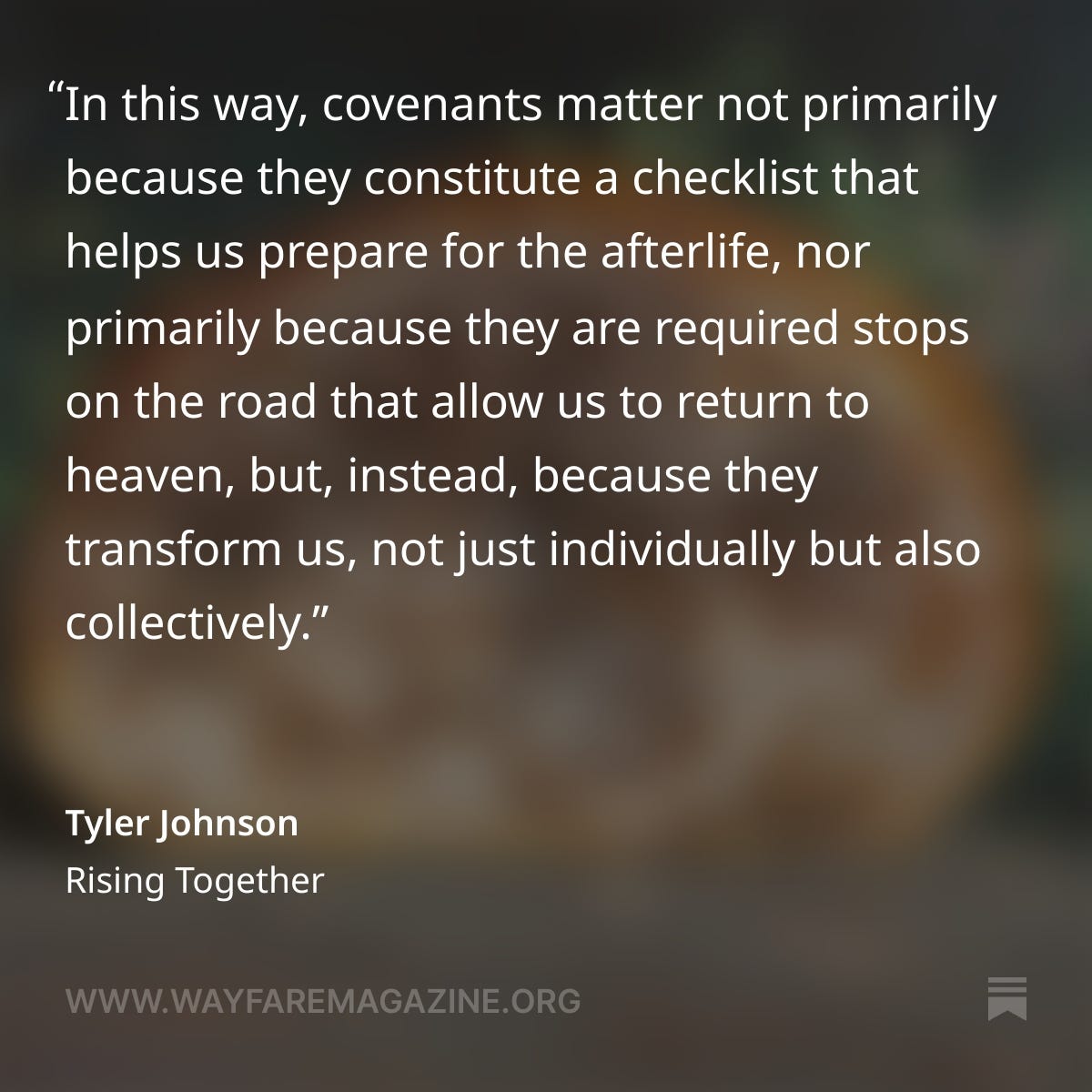
“As saints, many of us . . . live with a constant fear that we are failing to please [God], to measure up, as if He were looking for reasons to deny us the winner’s cup. We lose sight of the fact that God is running the race with us, not waiting at the finish line to declare us victor or loser.” —Terryl and Fiona Givens, All Things New
The final segment was a 2.5-kilometer run. Beginning the run, I felt like I had no reserves left. I jogged slowly but began to notice people around me who were walking. That sounded great to me. I didn’t want to do this in the first place, and I’ve had to deal with a bunch of dumb stuff up to this point, I reasoned. So, I think I’ve earned the right to walk for the final kilometers of this stupid triathlon.
Just as these thoughts entered my head, I noticed someone jogging beside me, matching my speed instead of passing me by. It was my bishop, who encouraged me to come in the first place.
Panting, he said, “Don’t give up just yet. I know you’re better than that. To be honest, I’m pretty tired too. But I told myself I would run the whole race. So how about you help keep me accountable? You don’t let me stop running, and I won’t let you stop running until we’ve both crossed that finish line. Deal?”
As I reflect on that triathlon all these years later, I think the power we receive from honoring our covenants is a lot like the strength and invigoration I felt while my bishop ran beside me, saying, “You can do this. I’m right here.” The role my bishop was playing is what I feel most accurately represents God’s role within a covenant relationship. Not an employer or a cheerleader but rather a collaborator. Honoring our covenants isn’t like being hired to do grunt work, but rather invited to join in the work of divinity.
—Travis Hicks, “My Side-by-side God”
Jesus Christ is my Deliverer.
I’ve never experienced anything that felt like pulling down divine power, suddenly being filled with strength, or having a burden evaporate. However, when I’m in step with the Savior, my burdens feel lighter. I have experienced peace that surpasses understanding (Philippians 4:7). I have experienced enough inspiration to take one more step. I have always had enough strength to get through all my days (Deuteronomy 33:25). I hope he is near me. And although the veil is thick, I do believe that Christ is on the other side of my covenants with him, walking me home.
—Brooklyn Miller, “Burdens and Yolks”